

Clematis vase






William Muckley
1829-1905
Description of the artwork
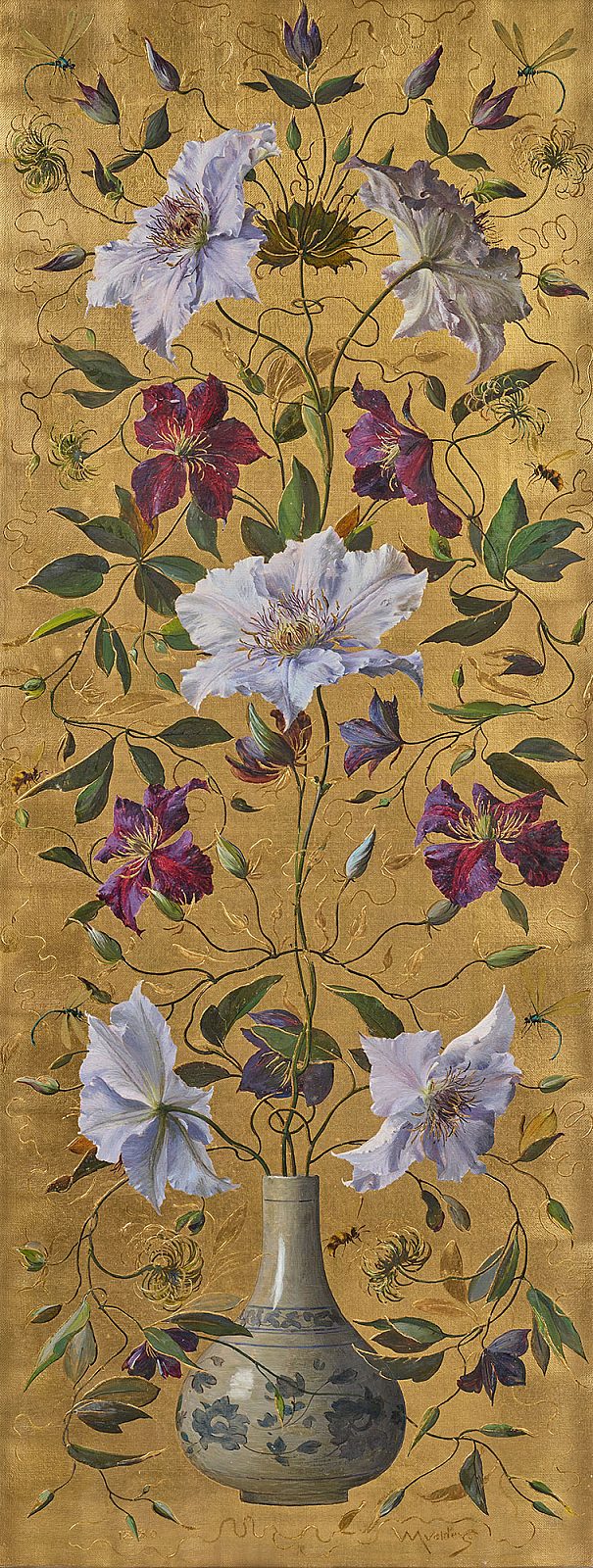
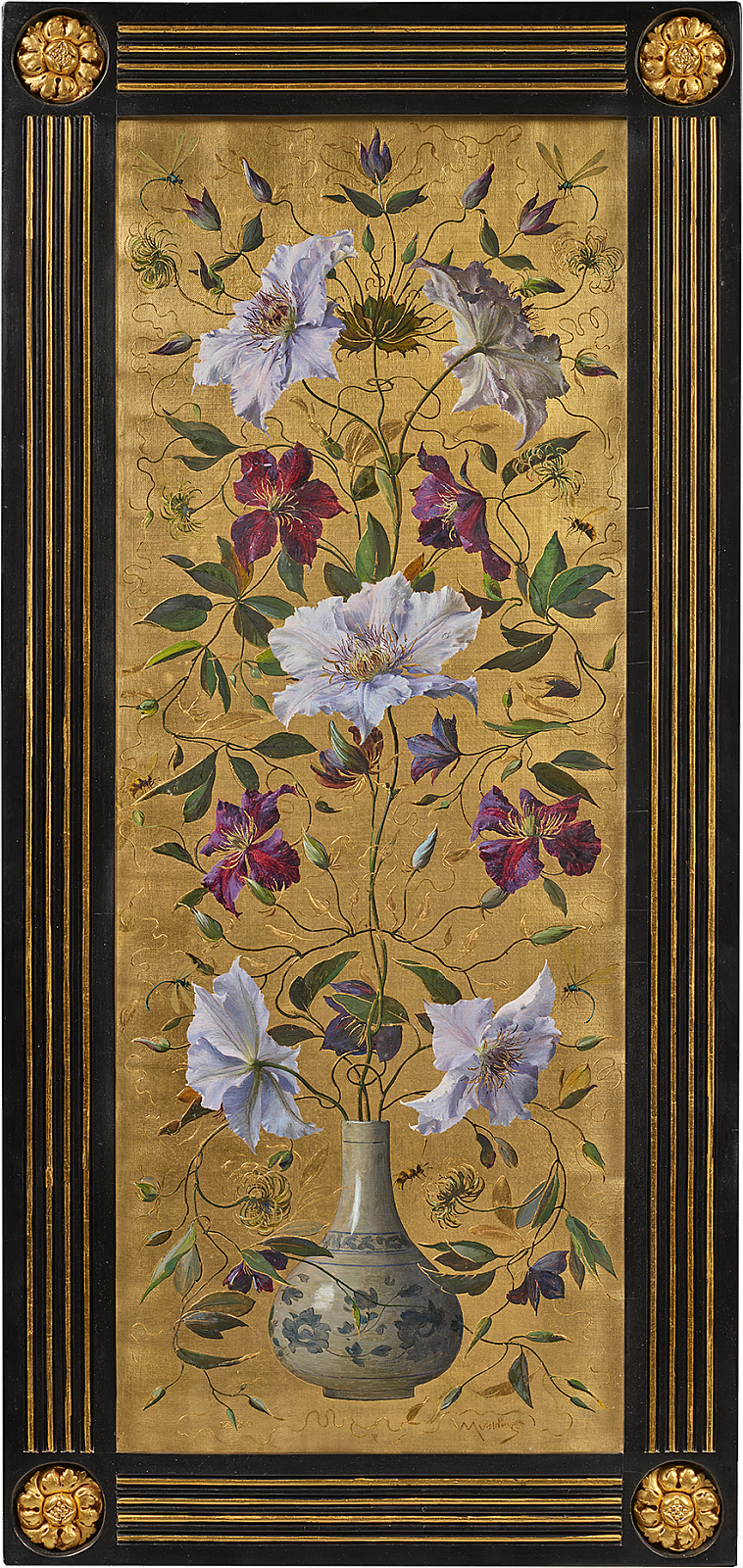
Striking for its imposing vertical format and the originality of its composition, the oil on canvas presented here vividly illustrates the dual artistic culture of William Jabez Muckley, both painter and theorist of the decorative arts. Conceived against a spectacular gold ground, the work stands at the intersection of easel painting and ornamental panel, revealing the artist’s ambition to elevate the floral motif to the status of an emblem.
At the centre of a narrow-necked baluster vase adorned with bluish decoration—directly inspired by Oriental ceramics—rises a stem of clematis whose tendrils trace a supple and carefully balanced network. The blossoms, shown at different stages of bloom, alternate between ivory tones and deep purple. The pale corollas, delicately modelled through subtle glazes, appear to capture a diffuse light that stands out vividly against the matte gold of the background. The darker flowers, of an intense purplish red, introduce a vibrant chromatic counterpoint, lending the whole composition an almost textile richness.
The overall structure rests upon a rigorous vertical symmetry characteristic of nineteenth-century British decorative aesthetics. Yet this order does not exclude variety or naturalism: the leaves incline, the petals curl, and some blossoms have already begun to fade. Fine spiral tendrils, almost calligraphic in their movement, animate the surface and recall the influence of contemporary theories of “design from nature,” which Muckley himself helped to disseminate through his writings.[1]
The gilded background, far from being a mere decorative device, plays a decisive role. It abolishes any illusionistic depth and projects the plant into a timeless space, reminiscent of a medieval altarpiece or a Japoniste panel. Punctuating the composition, insects—dragonflies and bees—introduce a discreet sense of movement, suggesting the cycle of pollination and the quiet vitality of the vegetal world. Within this almost abstract arrangement, only the vase appears to provide a tangible anchor, subtly recalling Muckley’s parallel activity in the field of ceramics and the applied arts.
Our canvas thus takes on the character of a manifesto: nature, observed with precision, is transformed into a structured motif capable of engaging in dialogue with interior architecture and the decorative arts—tapestry in particular. Dated 1880, it belongs to a period of artistic maturity during which Muckley fully asserted his conception of a total art, reconciling painting, ornament, and industry.
Through their carefully orchestrated harmony, The Clematis emerges as an aesthetic synthesis in which Victorian naturalism meets decorative rigor, in a floral celebration as distinctive as it is captivating.
[1] William Jabez Muckley, A Manual on Flower Painting in Oil Colours from Nature: With Instructions for Preliminary Practice; Also a Section on Flower Painting in Water Colours, London, Winsor & Newton, 1888.
Origin
Anonymous sale, Christie's London, 8 November 1996, lot 184
Former Ann and Gordon Getty Collection
Artworks to discover






75008 Paris, France
Saturdays from 2 to 7 p.m.