

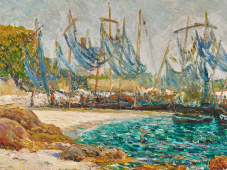
Coast of Clohars, Finistère 1903


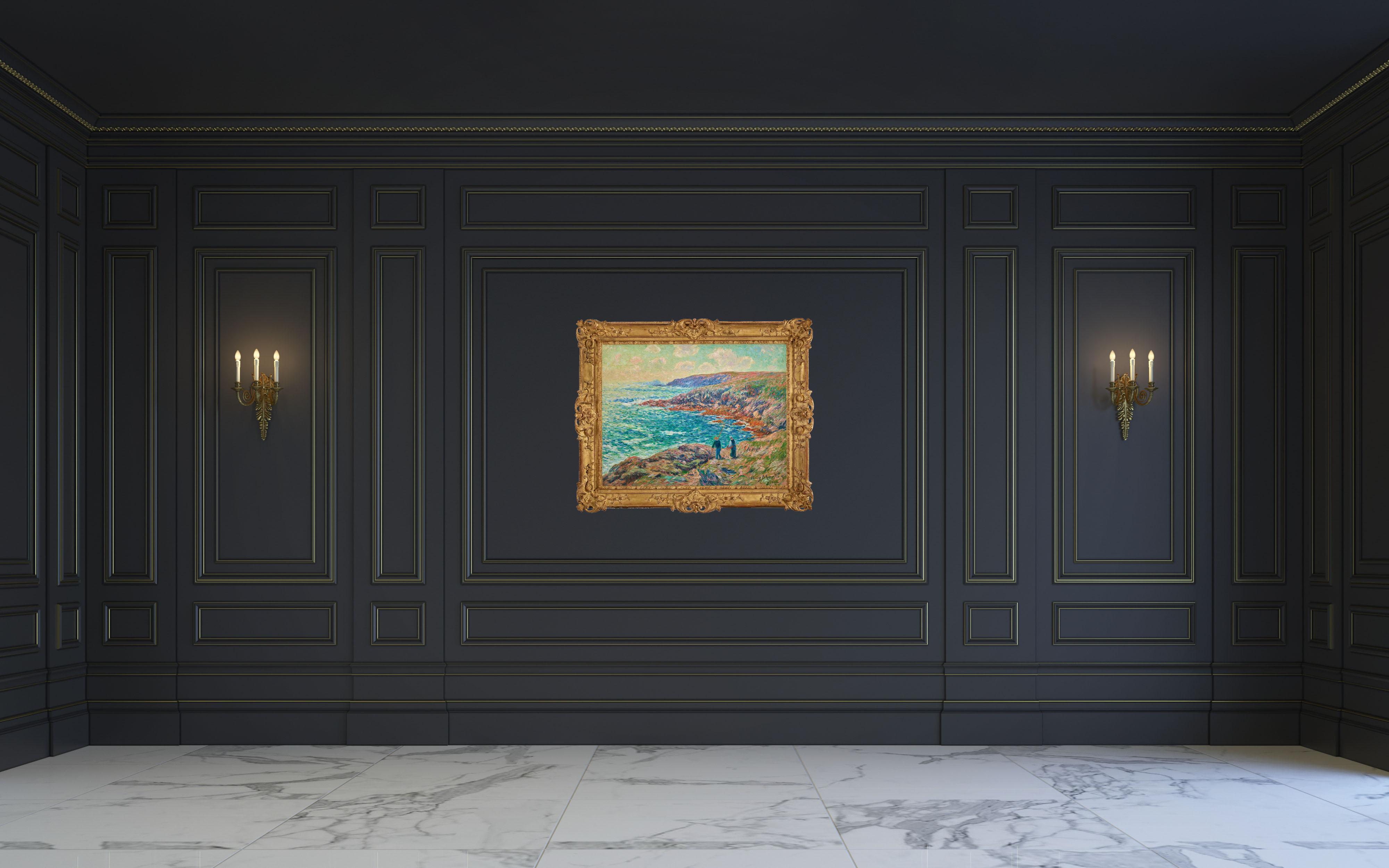
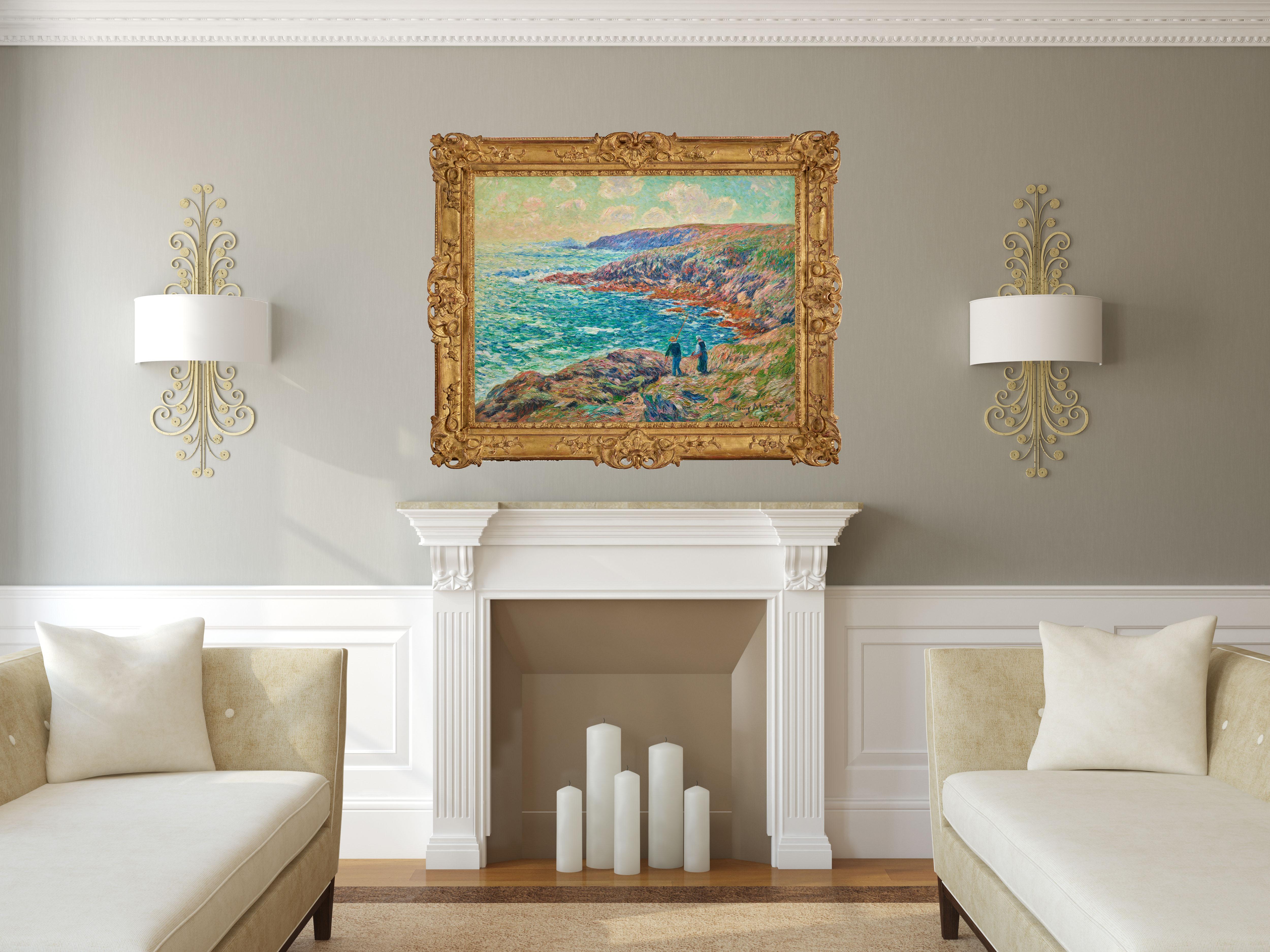



Salon d’Automne 1905, Paris, exhibited under the title «La Côte de Clohars (Finistère)», n° 1127
Description of the artwork
When the Salon d'Automne was created in 1903, Moret, with the agreement of his dealer Paul Durand-Ruel, was one of the first exhibitors in the basement of the Petit Palais. This independent exhibition, in reaction to the prevailing academicism, was intended to promote the avant-garde and innovative minds of their time. Henry Moret participated until 1911. After this initial success, the show moved to the glass and metal of the Grand Palais in 1904.
Our painting, exhibited at the 1905 Salon d'Automne under number 1127, obviously made less of a splash with the critics than Matisse, Derain, Vlaminck, Marquet or Van Dongen, whose exacerbated, violent colors catapulted them into the now-famous “cage aux fauves”. Henry Moret drew a certain bitterness from this, writing after the Salon to his friend Maufra that he had “never been a great supporter of the Salon d'Automne, suspecting that it could only be a store for a few intriguers...”. He concludes his letter by expressing his total lack of interest in this milieu, leaving to “paint from nature in Raguenez”.
In this unusually large painting, Moret offers us a moment of truth as a keen observer of the natural world around him. As is often the case, he has chosen to overhang the coastline, partially uncovered by the ebbing tide. He invites us to join the couple as they head down to the sea to gather seaweed. On this fine summer morning, we can feel the wind swelling the waves and stirring the vegetation. The juxtaposition of nervous strokes allows us to feel the swell and the sea air. A few round clouds cross the sky, still pale with the first rays of the sun, which fades to the horizon in a tumult of yellow and pink strokes.
Origin
Bought from the artist by Durand-Ruel Paris the
13th september 1905
sold to Ch. Haviland on 03/02/1906
Private collection, UK
Literature
Work numbered 5429 by Durand-Ruel
Certificate of authenticity by Jean-Yves Rolland dated 26th April
2022
Available artworks



75008 Paris, France
Saturdays from 2 to 7 p.m.