

dreamlike knight


Maurice Langaskens
1884-1946
Description of the artwork
Painted in 1904, when Maurice Langaskens was only twenty years old and still studying under Constant Montald at the Royal Academy of Fine Arts in Brussels, The Dreamlike Knight is an exceptional example of the artist's early work, a period that is seldom represented on the market today. Trained as a decorative painter, Langaskens was then developing a highly personal visual language shaped by Art Nouveau and Symbolism, before the First World War and his prolonged captivity would profoundly alter the course of his artistic career.
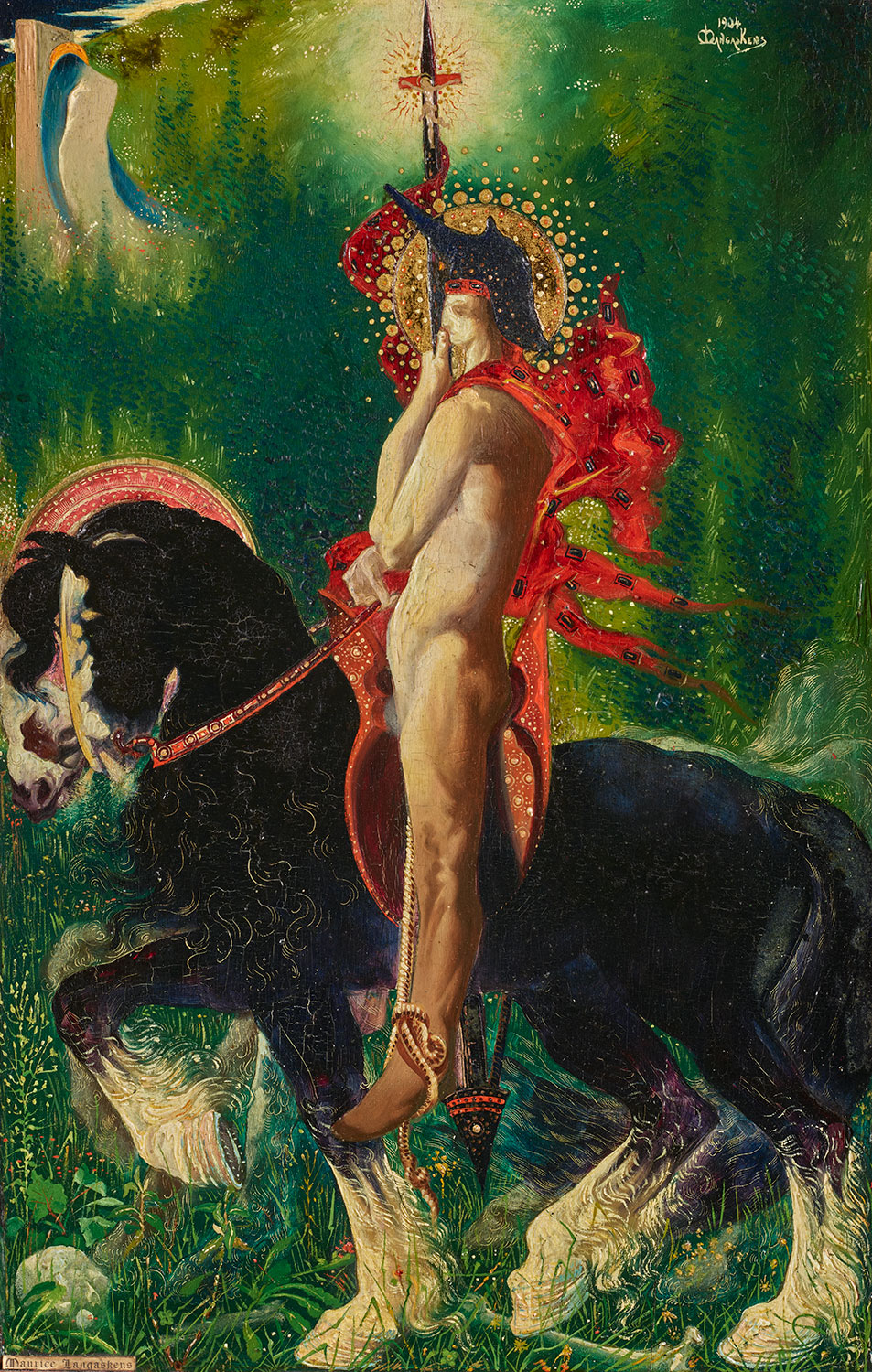
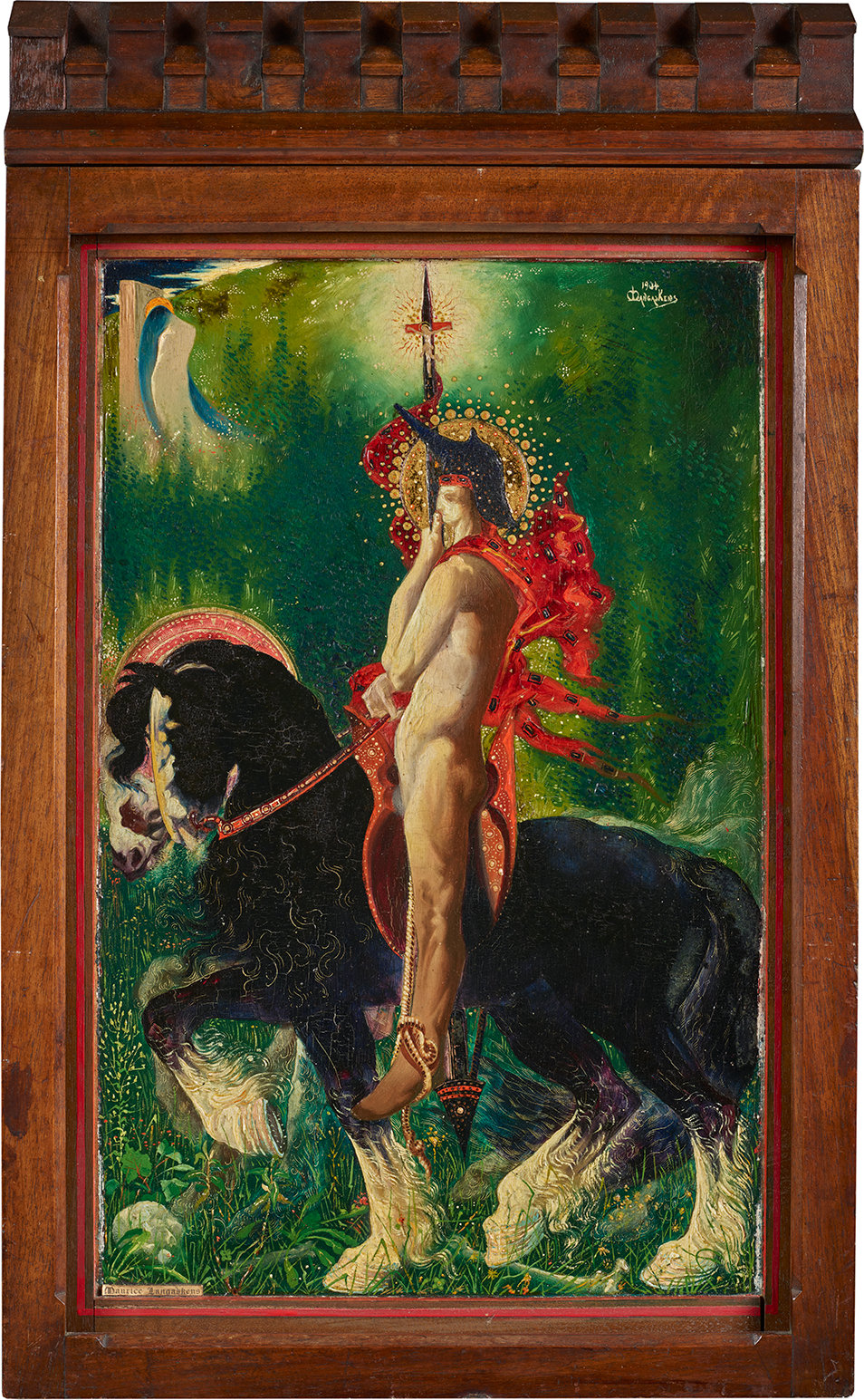
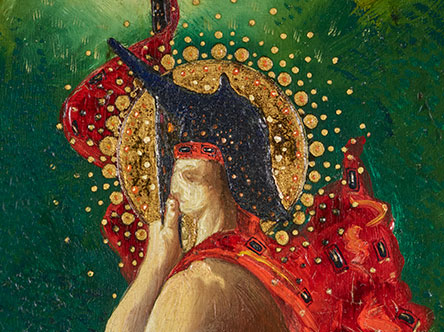
The composition depicts a young nude knight, wearing a medieval helmet and wrapped in a flowing crimson cloak, riding a powerful black horse through a silent, dreamlike landscape. A slender crescent moon illuminates the scene, while a white-clad figure appears in the distance beside a waterfall. Nothing in the composition belongs to the realm of historical narrative; instead, the painting unfolds as a vision, suspended between dream and allegory.
The knight was one of the great recurring motifs of European Symbolism, yet Langaskens offers a remarkably personal interpretation. Stripped of his armour, the rider is transformed from a medieval warrior into an inward-looking figure, embodying ideals of purity and spiritual elevation. His lance, extending into a radiant halo, becomes a symbolic axis linking the earthly world with a higher realm, while the imposing black horse carries its mysterious rider through a landscape poised between reality and imagination.
The painting fully reflects the intellectual climate of Belgian Symbolism, whose leading exponents included Fernand Khnopff, Jean Delville and Léon Frédéric. Constant Montald's influence can be sensed in the decorative conception of the picture surface, the stylised vegetation and the sumptuous treatment of the drapery. Deep greens and velvety blacks envelop the scene in a nocturnal atmosphere, while the brilliant reds of the cloak and subtle golden highlights naturally draw the eye towards the central figure, bathed in an almost supernatural light.
By virtue of its early date, The Dreamlike Knight occupies a distinctive place within Maurice Langaskens' oeuvre. Painted several years before the drawings and watercolours produced during his captivity, which would later establish his reputation, it reveals a remarkably accomplished young artist whose personal style, already deeply rooted in the ideals of Symbolism, reflects the golden age of Belgian art at the turn of the twentieth century.


75008 Paris, France
Saturdays from 2 to 7 p.m.