

Feloucs and camel riders by the Nile





Narcisse Berchère
1812-1891
Narcisse Berchère: From the Orient to the Étampes Region, Étampes Museum, May 18–September 22, 2019
Description of the artwork
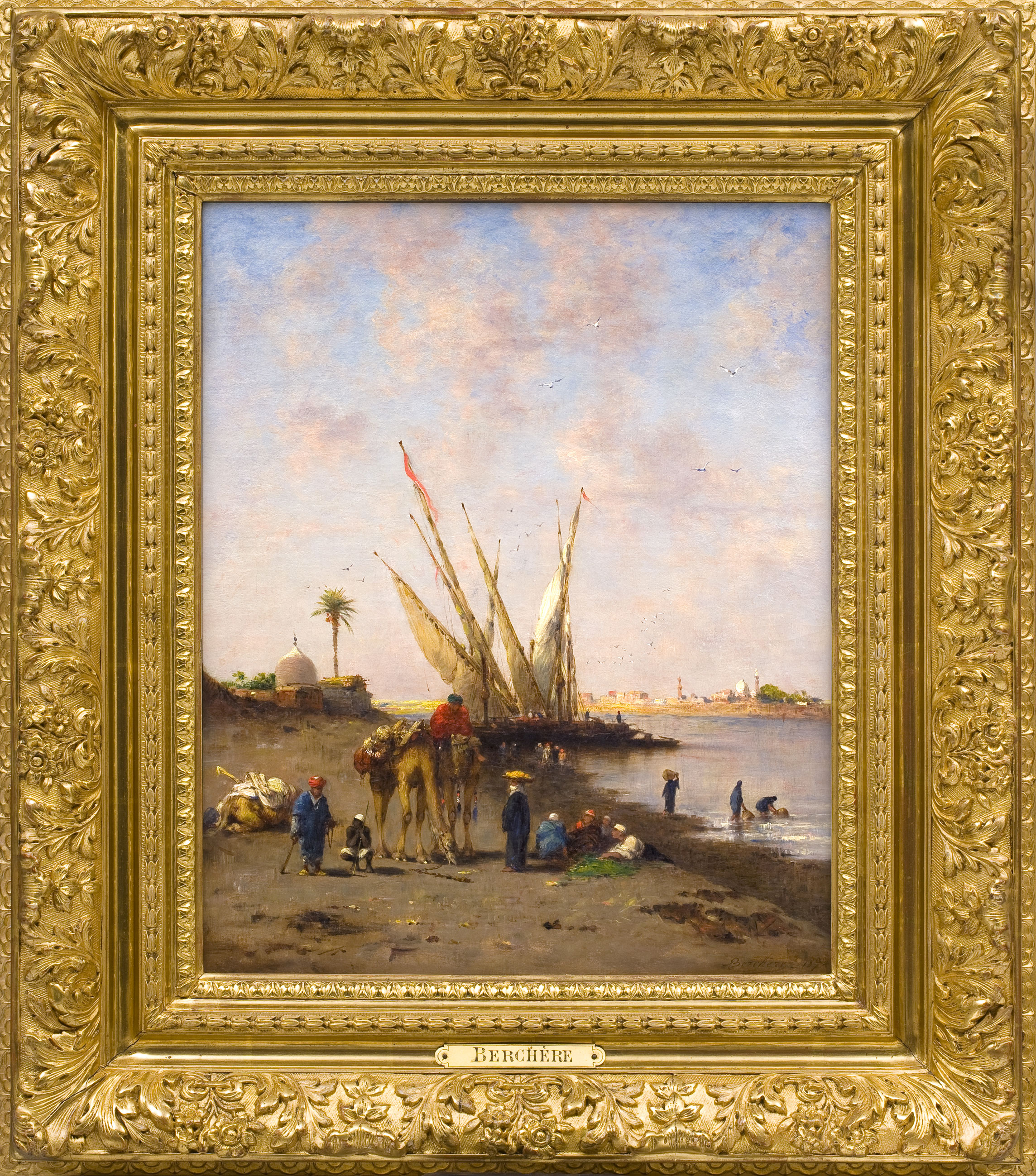
In this view of the banks of the Nile, Narcisse Berchère offers a lively yet luminous evocation of Egypt, a country that held a central place in his work. Rather than focusing on the monumental remains of antiquity, the artist turns his attention to everyday life along the river: camel drivers pause on the bank, figures gather and work by the water, while the tall sails of feluccas rise at the centre of the composition. This repertoire is characteristic of Berchère’s Egyptian landscapes, in which merchants, boats and scenes of daily life frequently animate the banks of the Nile.
The composition is structured around a subtle interplay of vertical lines. The slender silhouettes of the palm trees are echoed by the masts and triangular sails of the feluccas, whose irregular forms enliven the centre of the painting. In the foreground, camels and small groups of figures introduce touches of deep blue, red, yellow and white that punctuate the warm, earthy tones of the riverbank. Despite the precision of these details, Berchère does not isolate his figures: people, animals and boats are fully integrated into the landscape, emphasising the vastness of the setting that surrounds them.
Above all, it is the treatment of light that gives the scene its distinctive character. The sky occupies almost two-thirds of the canvas, unfolding in delicate shades of blue, pink and mauve, with softly defined clouds drifting across its surface. This luminous palette is reflected in the calm waters of the Nile and contrasts with the ochres of the foreground. A few birds scattered across the sky further enhance the sense of space. Berchère’s taste for expansive skies and subtle atmospheric effects can also be found in Sakieh on the Banks of the Nile of 1865, now in the Musée des Beaux-Arts in Tours, a work admired in its time for the clarity and warmth of its colouring.
Berchère thus makes the Nile not merely the setting for an Orientalist scene, but the true organising principle of the composition. Human activity is concentrated along its banks, while the river draws the eye towards the distant horizon, where architecture, minarets and sails gradually dissolve into the light. Careful observation is combined here with remarkable atmospheric delicacy: through the shimmering sky, reflections on the water and finely rendered silhouettes, Berchère captures the distinctive Egyptian light that runs as a constant thread throughout his work.
Origin
Private collection, France
Literature
Reprinted in “Oriental Dreams” by Mathias Ary Jan, Editions Norma, p. 161
Artworks to discover


75008 Paris, France
Saturdays from 2 to 7 p.m.