

Grey stallion and greyhound


Alfred De Dreux
1810-1860
Signed "Alfred de Dreux" lower right
Description of the artwork
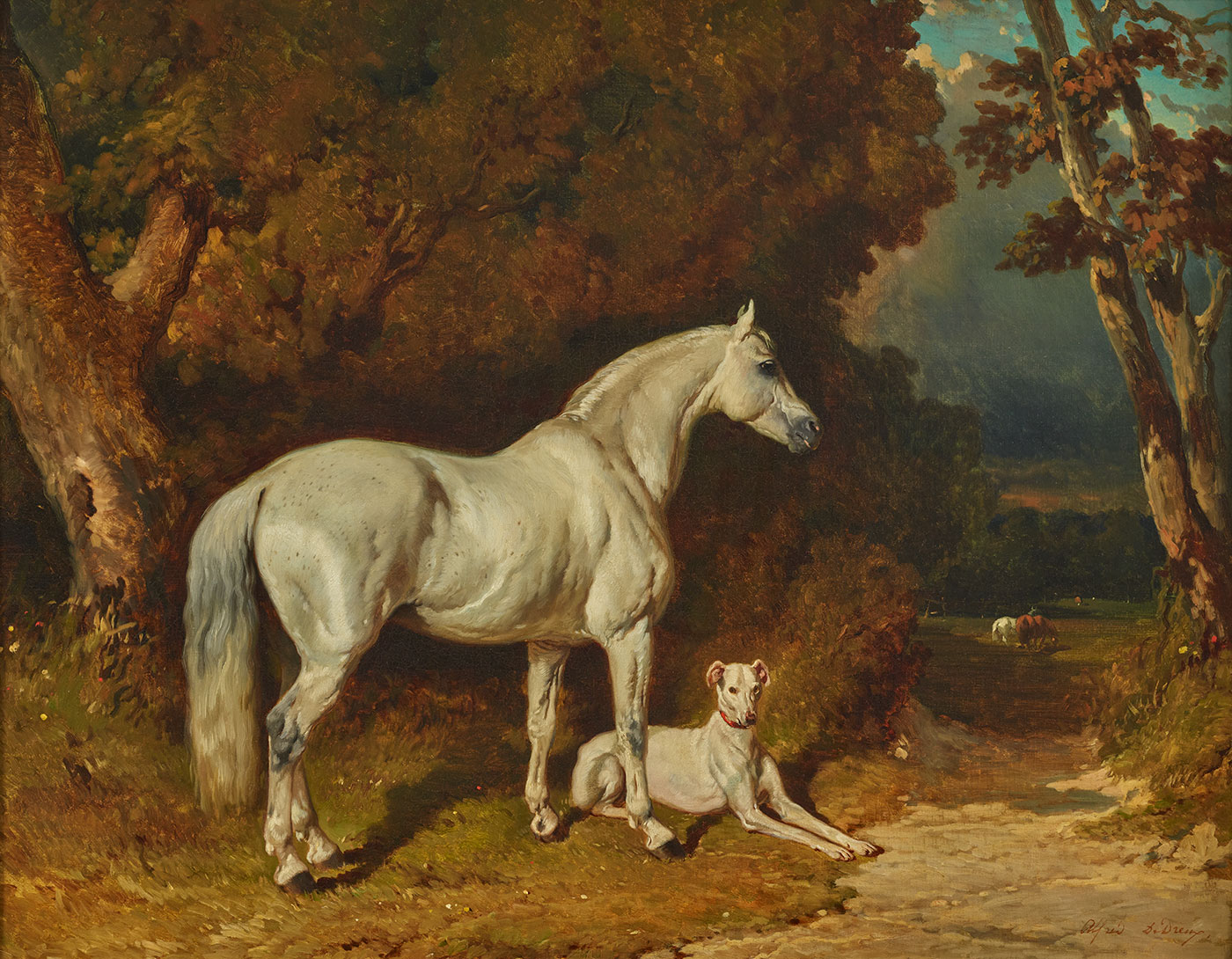
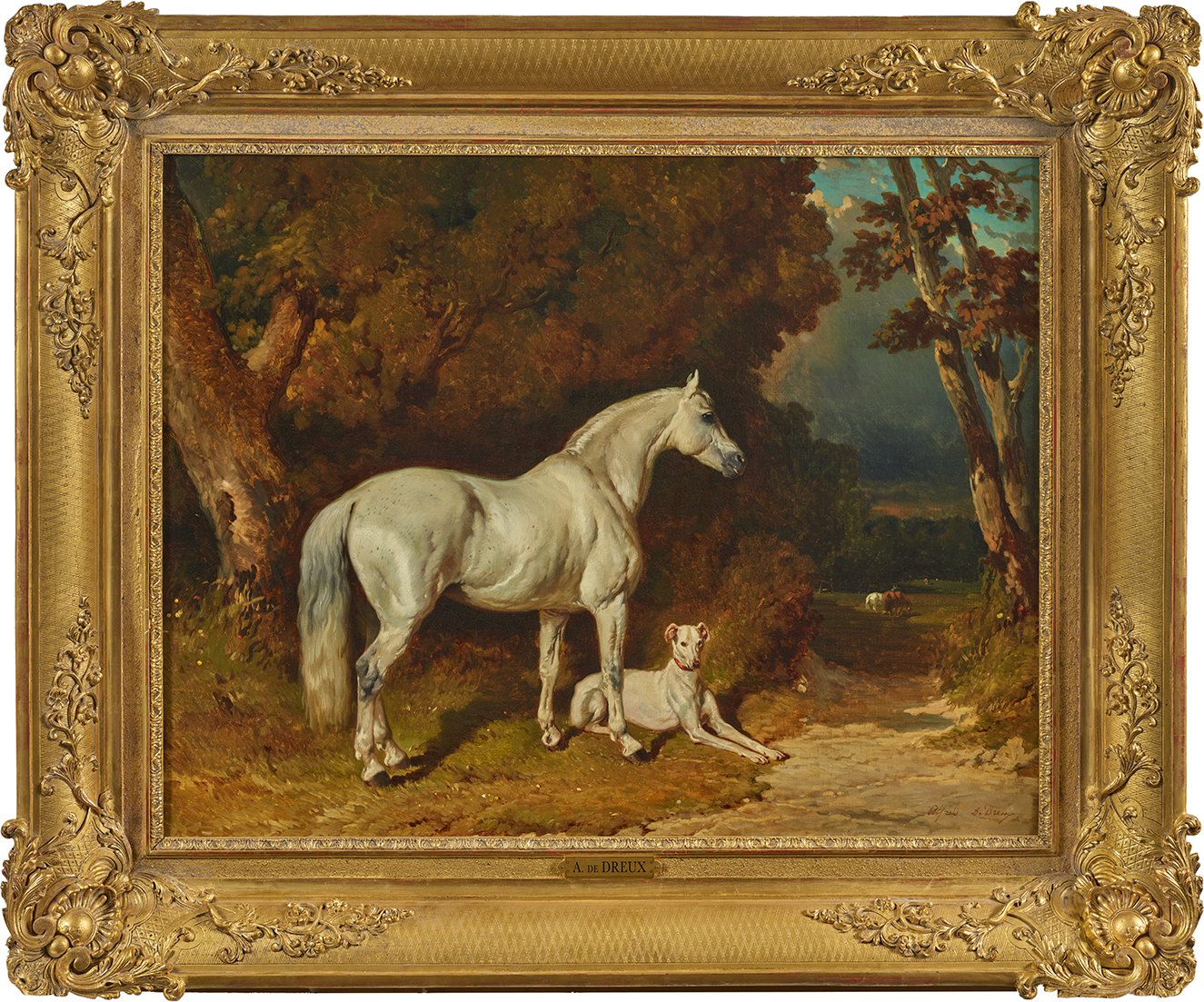
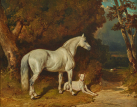
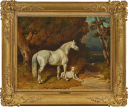
Executed around the mid-1850s, our large canvas by Alfred de Dreux belongs to the tradition of grand equestrian representations that secured the artist’s renown. The composition is organized around the central figure of a grey stallion, shown in profile and firmly grounded on the forest floor. The posture is noble, almost sculptural, the neck raised with confidence. The musculature, delicately shaped by light, reveals a careful observation of equine anatomy. Every contour of the chest, every tension of the thigh is rendered with a precision that betrays Dreux’s deep familiarity with the horse.
At its feet lies a white greyhound, stretched out, whose slender line and refined silhouette visually echo the elegance of the stallion. By associating the restrained power of the horse with the nervous finesse of the dog, the artist seems to establish a subtle dialogue between strength and grace.
Inspired by the lessons of the English painters, Alfred de Dreux gives the landscape an essential role in balancing his composition. On the left, a cluster of trees with browned foliage frames the scene and accentuates the pearly, luminous reflections of the stallion’s grey coat. On the right, the opening of a sunlit path toward a more distant horizon introduces a necessary sense of depth. The discreet presence of other horses in the distance reinforces the aristocratic character of the setting by suggesting a large estate. The warm palette, dominated by golden browns and muted greens, creates a harmonious contrast with the animals’ light coats, bathed in light. As if torn between rigorous naturalism and his Romantic sensibility, the artist alternates between precision of drawing—particularly in the anatomical treatment—and freer, more spirited brushstrokes in the rendering of foliage and ground.
Beyond a simple animal scene, Alfred de Dreux appears here to celebrate a timeless aristocratic ideal: the horse embodying nobility, prestige, and the mastery of strength, and the dog loyalty and discipline. Above all, by combining technical virtuosity, formal elegance, and a keen sense of observation, this canvas ranks among the artist’s finest ceremonial portraits, magnifying the sovereign and incomparable beauty that the equestrian world held in his eyes.
Origin
Anon. sale, Drouot Richelieu, Paris, 19 June 1998, lot 46
Private collection, France
With Richard Green, London
Acquired from the above by 2003
Sale, Sotheby's, New York, The Gilded Age Revisited: Property of a Distinguished American Collection, 2 February 2019, lot 867
Private collection, acquired at this latest sale
Literature
Marie-Christine Renauld, L'univers d'Alfred De Dreux, 1810-1860, suivi du catalogue raisonné, Arles, 2008, part I, p. 28, illustrated; and part II, p. 69, no. MCR 301


75008 Paris, France
Saturdays from 2 to 7 p.m.