

Orpheus


Description of the artwork
During the late nineteenth century, the myth of Orpheus and Eurydice experienced a renewed fascination among Symbolist artists, who saw in it far more than an episode from classical mythology. It became a meditation on love, death and the spiritual power of art. With this remarkable pair of decorative panels, Luc-Olivier Merson offers a deeply poetic interpretation in which narrative gives way to atmosphere and symbolism.
Rather than depicting the dramatic moment when Orpheus turns to look back at Eurydice, Merson isolates the two protagonists in independent yet complementary compositions. Their physical separation reflects the irreversible distance that now divides them: Orpheus still belongs to the world of the living, while Eurydice already seems absorbed into the realm of shadows. The viewer is thus invited to reconstruct the story mentally, in a thoroughly Symbolist approach where suggestion takes precedence over literal narration.
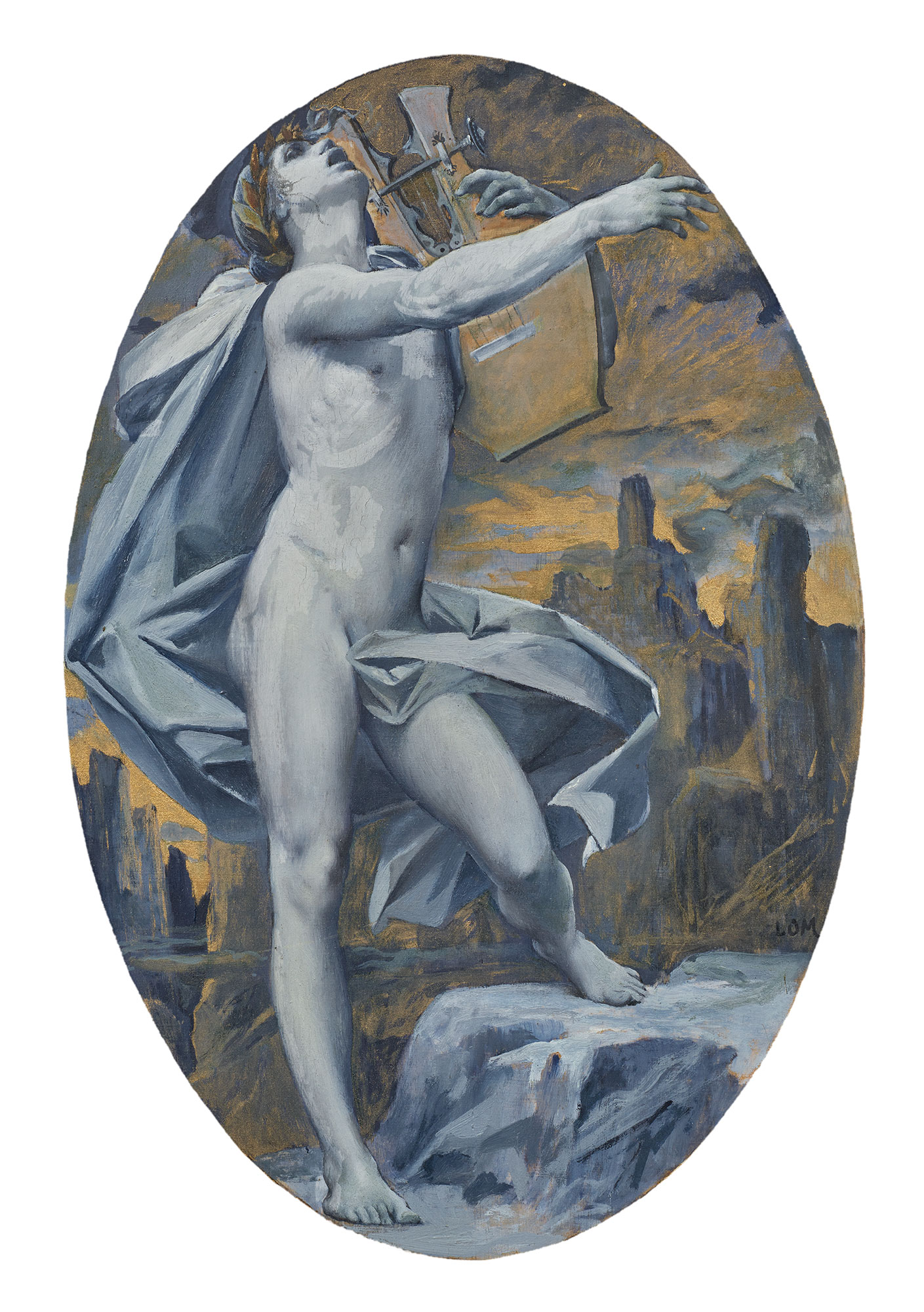
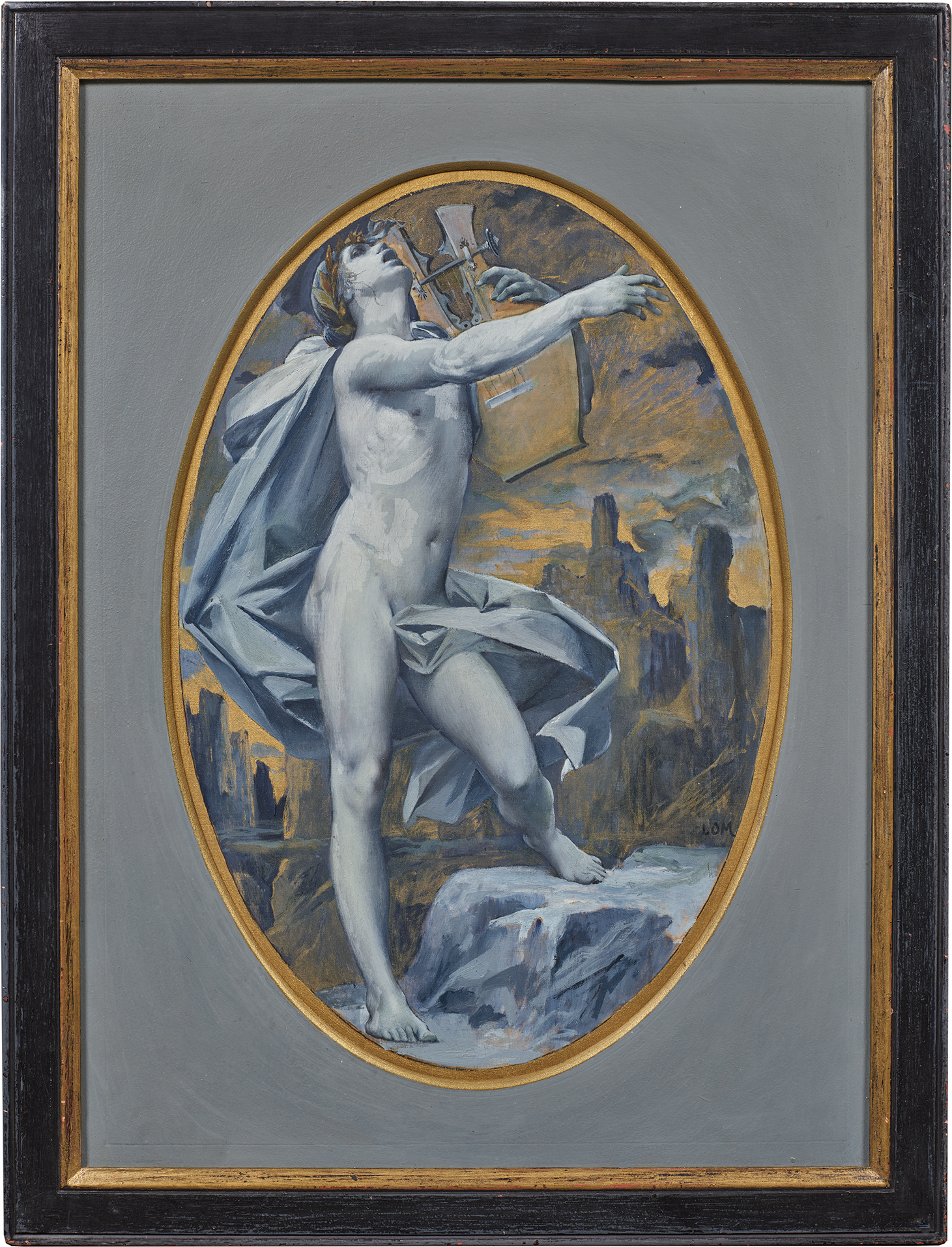
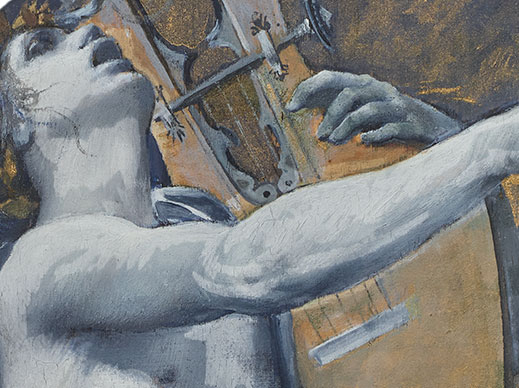
Orpheus stands with his lyre held close to him, his body caught in an almost ecstatic moment of inspiration. His face is turned heavenward, evoking the divine gift that enabled his music to move men, animals and even the gods of the Underworld. The sweeping cloak surrounding his figure animates the composition with a broad, rhythmic movement, while the rocky landscape, reduced to monumental silhouettes bathed in a golden twilight, lends the scene a timeless quality.
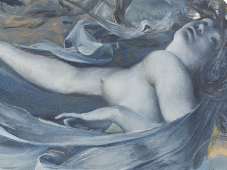
Opposite him, Eurydice appears to float within an immaterial space. Her body rises in an ascending movement, enveloped in a translucent veil that gradually dissolves the contours of her figure. The flowers adorning her hair recall the young bride whose life was cut short in the spring of her youth, while the dark birds crossing the sky discreetly evoke her passage into the afterlife. Rather than portraying a tragic heroine, Merson transforms Eurydice into a fleeting apparition whose presence seems already to merge with air and light.
These two panels perfectly exemplify Luc-Olivier Merson's artistic vision. While remaining faithful to the rigorous draughtsmanship inherited from the French academic tradition, he moves beyond conventional history painting to create a more evocative language closely aligned with Symbolist ideals. His classically inspired figures, rendered with sculptural precision, are enveloped in flowing draperies of almost immaterial lightness, whose graceful curves recall both the harmony of the Italian Renaissance and the decorative vocabulary of Art Nouveau.
The deliberately restrained palette plays a fundamental role in shaping the dreamlike atmosphere of the works. Delicate shades of bluish-grey, enriched with gold emulsion that subtly catches the light, create a refined chiaroscuro in which the figures seem to emerge from an ethereal, otherworldly realm. This sophisticated chromatic harmony recalls Merson's designs for stained glass and monumental decorative schemes, revealing his enduring interest in the dialogue between painting, architecture and the decorative arts.
The oval format further enhances the timeless character of the compositions. Enclosed within these medallion-like spaces, Orpheus and Eurydice assume the appearance of monumental cameos, inviting quiet contemplation rather than narrative interpretation. In doing so, Merson joins artists such as Pierre Puvis de Chavannes, Gustave Moreau and Carlos Schwabe, all of whom sought to transcend anecdote in favour of an idealised form of painting capable of expressing the inner life of the soul.
Through their perfect complementarity, these two panels stand among the finest examples of French Symbolist decorative painting around 1900. By translating the myth from Ovid's Metamorphoses into a language of remarkable formal restraint and lyrical beauty, Luc-Olivier Merson does more than illustrate the story of Orpheus and Eurydice: he transforms it into a universal allegory of unattainable love, memory, and the redemptive power of artistic creation.
Origin
Private collection
Literature
Francis Ribemont, *The Strange Mr Merson*. Catalogue of the exhibition held at the Rennes Museum in 2008–2009. Works reproduced on pages 166 and 167 (the dimensions given in the catalogue are those of the mountings).
Artworks to discover


75008 Paris, France
Saturdays from 2 to 7 p.m.