

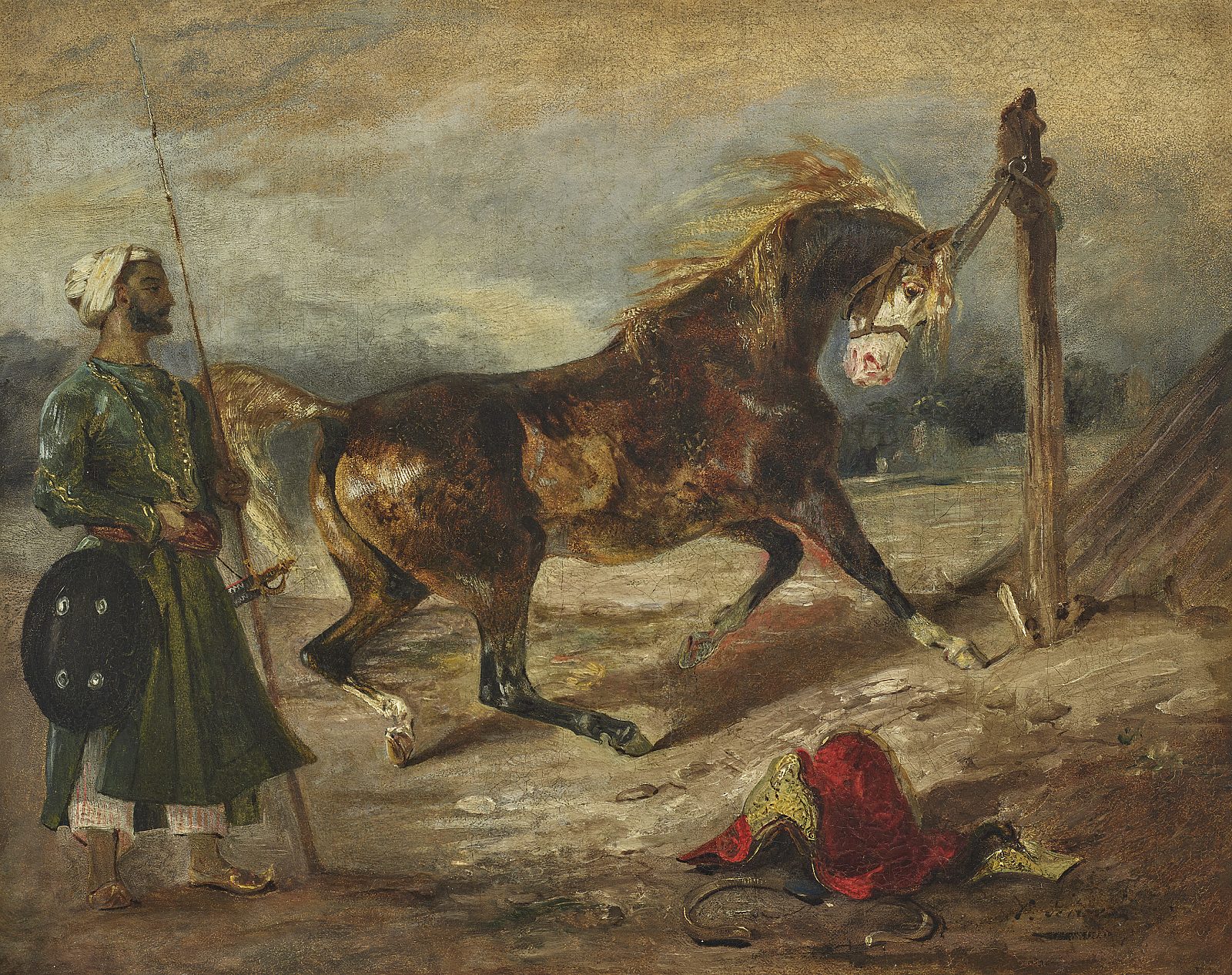
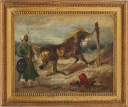
Arabian horse tied to a stake



Eugène Delacroix
1798-1863
Paris, École Nationale des Beaux-Arts, Eugène Delacroix, 1885, cat. no. 115: ‘Syrian Arab and his horse tied to a stake’.
Paris, Louvre Museum, Eugène Delacroix, June–July 1930, cat. no. 204A: ‘Persian horse pulling a fox’.
Description of the artwork
The remarkable oil on canvas we present here ranks among Eugène Delacroix’s earliest Orientalist variations, executed around 1825 during the artist’s journey to England, several years before his decisive stay in Morocco.
In this dense and energetic composition, the artist places at its centre a dark horse tethered to a stake, captured in a violent backward movement as if attempting to break free from its restraint. The neck stretches taut, the mane bristles, and the eye glints with anxious intensity: with only a few swift brushstrokes, Delacroix succeeds in conveying the convulsive energy of the animal. To the left, a standing figure—impassive and almost hieratic—observes the scene calmly, heightening by contrast the fiery spirit of the thoroughbred.
Long described in catalogues as depicting an Arab or Turkish rider, the scene now appears in a more precise light: the standing figure on the left is in fact likely an Indian, whose weapons—the lance, shield and sword—seem directly inspired by objects admired by Delacroix in the celebrated collection of Samuel Rush Meyrick at Cadogan Place, which he visited on 9 July 1825 and later described as “the finest collection of armour that may ever have existed.”[1]
On the ground, the abandoned saddle—probably of Maratha type—together with other Oriental accessories introduces a subtle and carefully studied picturesque note. Yet it does not distract from the true subject, which is profoundly Romantic in essence: the dramatic tension between constraint and impulse. The low sky, the subdued tones of the landscape and the vibrant, sometimes almost agitated paint surface give the whole scene a stormy and unstable atmosphere, in which the study moves beyond any ethnographic dimension in favour of an intensely expressive vision.
Probably inspired by one of the horses belonging to the horse dealer Adam Elmore—who was close to both Delacroix and Géricault during their stay in England—this painting already reveals one of the painter’s greatest gifts: his singular ability to unite close observation of reality, a taste for exoticism, and a powerful expressive intensity that transforms the horse from a simple motif into the living, burning and tragic soul of the composition.
The provenance of the work further enhances its historical interest. It appeared early within the artistic circle surrounding Delacroix, having belonged to Hippolyte Poterlet before being acquired by the landscape painter Paul Huet. After passing into the collection of Amable-Paul Coutan, it resurfaced at his Paris sale on 19 April 1830, where Huet repurchased it, testifying to the lasting admiration he held for the work of his friend.
It was while The Arabian Thoroughbred formed part of this collection, well known among painters, that Félix Bracquemond produced an important engraving of it in 1857 (fig. 1), which contributed to its wider dissemination. Remaining in the Huet family until 2001, the work later entered the prestigious collection of the actor Alain Delon, whose passionate eye for nineteenth-century painting further confirms its remarkable character.
[1] Letter from Delacroix to Théophile Thoré, 30 November 1861, in Burty, P., Lettres de Eugène Delacroix (1815–1863), Paris, A. Quantin, 1878, p. 344.
Origin
Hyppolyte Poterlet (1803–1835).
Paul Huet (1803–1869), acquired from the previous owner for 90 francs.
Amable-Paul Coutan (1792–1837); sold in Paris on 19 April 1830, lot 30: ‘Horse tied to a post; behind it is an Arab warrior watching its movements as it tries to break free’.
Paul Huet (1803-1869), acquired at this latter sale for 110 francs.
Then passed down to his son René Paul Huet (1844-1928); by descent to his son-in-law Maurice-Perret-Carnot (1892-1977) in 1928.
Private collection, Paris.
Anonymous sale, Paris, Gros et Delettrez, 17 December 2001, lot 166.
Alain Delon (1935-2024).
Literature
Probably Sylvestre, T., Histoire des artistes vivants français et étrangers, études d'après nature, Paris, 1855, p. 80: “Horse with an Indian (England)”.
Robaut, Alfred, L’œuvre complet d’Eugène Delacroix, Paris, Charavay frères éditeurs, 1885, pp. 162-163, cat. no. 610, reproduced (drawing by Robaut).
Huet, R. P. Paul Huet, Paris, 1911, reproduced p. 26.
Joubin, A., Correspondance générale d'Eugène Delacroix, Paris, 1935-1938, vol. III, no. 11 p. 374. Johnson, L., The paintings of Eugène Delacroix. A Critical Catalog. 1816-1831, 1981, Oxford, vol. I, p. 27, cat. no. 37, vol. II, pl. 32.
Certificate of authenticity, delivered by the Comité Eugène Delacroix
Artworks to discover


75008 Paris, France
Saturdays from 2 to 7 p.m.