

Behind the scenes at the Opera


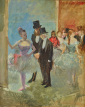
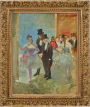
Jean-Louis Forain
1852-1931
Circa 1887
Paris, Galerie Bernheim-Jeune & Cie, Paris, Exhibition of One Hundred Years of Theatre, Music Hall and Circus, 1936, No. 50 on loan from Miss Jane Renouardt (label on the reverse).
New York, The Metropolitan Museum of Art, on loan, exhibited in 1972, 1977, 1978, 1980
Exhibition of One Hundred Years of Theatre, Denver Art Museum, The Lefevre Gallery (label on the back)
Description of the artwork
When, in 1888, Le Courrier Français asked Forain for an autobiography, he replied: “I was born in Reims on October 23, 1852, and I love dance.”
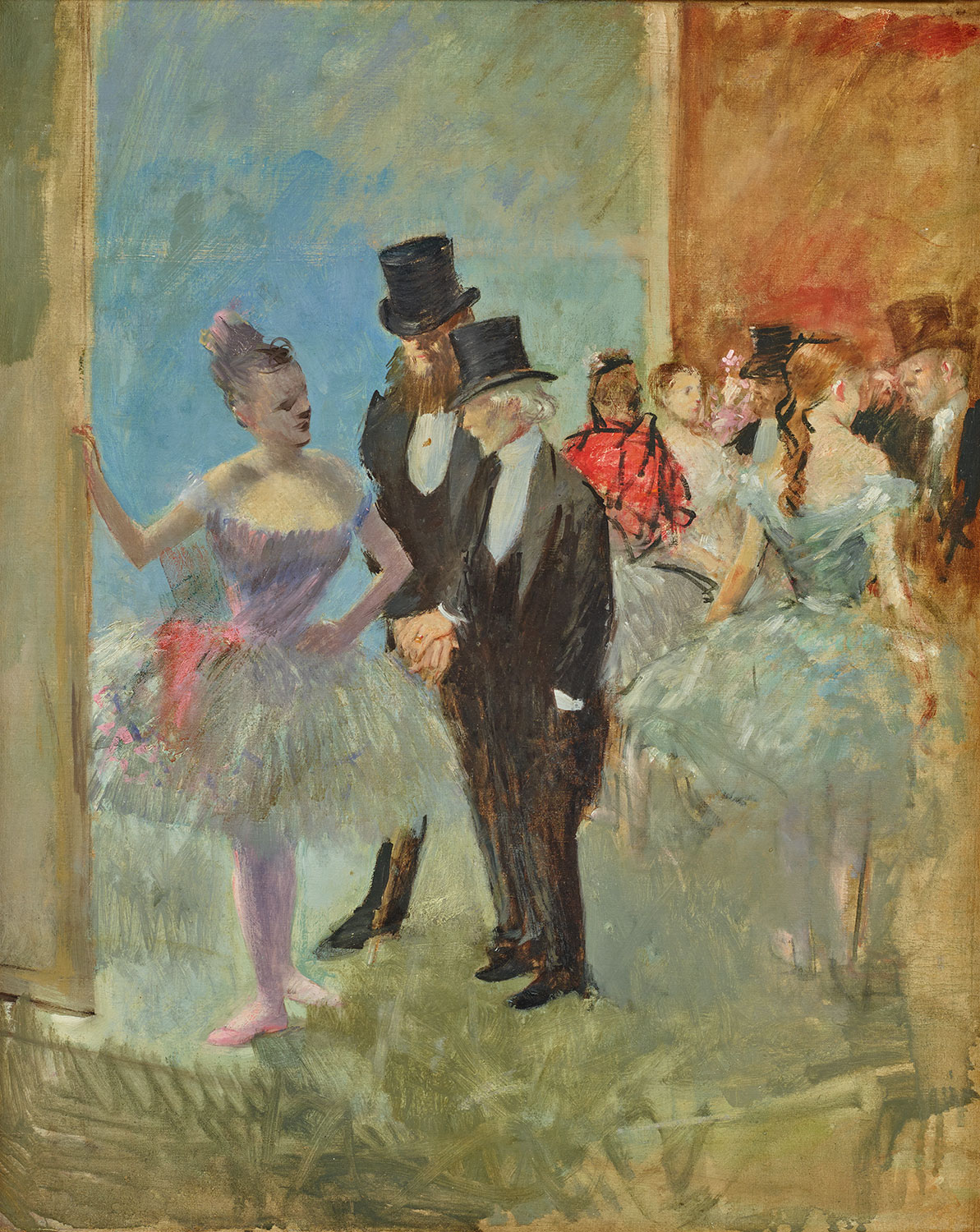
Like Degas, his friend and elder, Jean-Louis Forain became interested from the 1880s onward in the backstage world of the Opera—not to glorify its ideal grace, but to reveal its ambiguities. The oil on canvas we present belongs to this theme, one of the most fertile in the artist’s work, exposing the reverse side of Parisian décor, that social theater where artists, high society figures, and members of the demi-monde intersect.
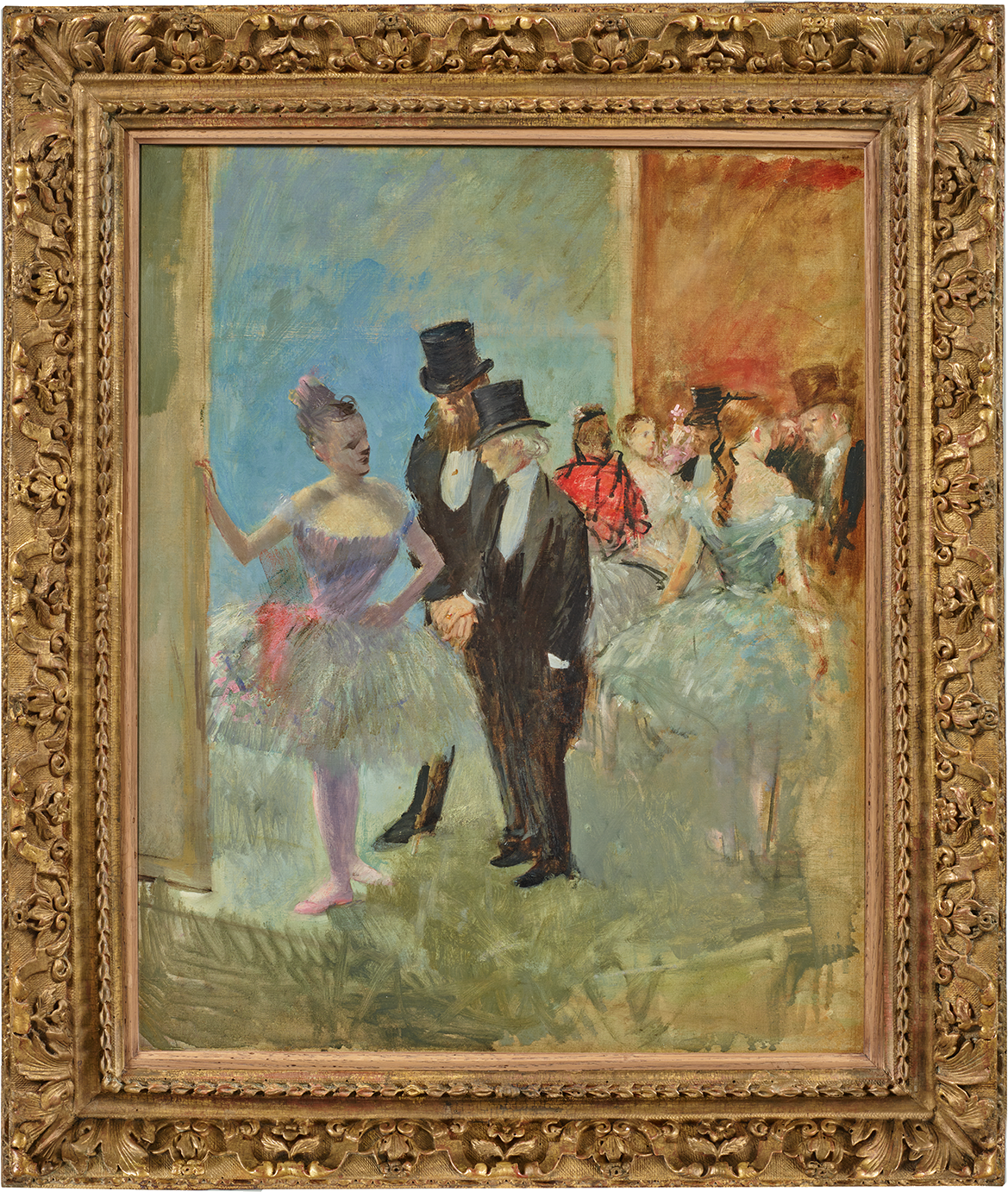
The subject does not depict the performance itself, but the waiting— a suspended moment in which the dancer, positioned to the left of the composition, stands at the edge of the stage still bathed in light. Wearing her airy tutu, lilac bodice, and pink slippers, she leans nonchalantly against the stage backdrop, facing the two Opera subscribers in black evening dress and top hats who occupy the center of the composition.
To subtly convey the implicit tension of this type of interaction, the artist heightens the contrast between the diaphanous lightness of the tutus and the rigid verticality of the two men, emphasizing the deep black of their frock coats and the stark whiteness of their shirtfronts. On the right, in a warm half-light, other groups of dancers and subscribers appear, sketched with rapid, incisive, and vibrant strokes.
A vivid red bodice introduces a fiery note that disrupts the pastel harmony and draws the eye toward the background. Here, Forain orchestrates a subtle chromatic arrangement: the cool blues of the wall and the softened greens of the floor are answered by the ochres and oranges of the wings, as if suggesting the fusion of two worlds—that of the stage and that of worldly desire.
Faithful to his Impressionist aesthetic principles, he succeeds in capturing movements, expressions, and attitudes while leaving each brushstroke visible. This lively, free handling—particularly evident in the trembling petticoats and the barely defined silhouettes in the background—conveys the immediacy of the gaze, but also the moral ambiguity of the subject. The backstage area becomes a space of silent transaction, where the ballerina, a figure of grace, turns into an object of desire. Thus, beneath the apparent lightness of a ballet scene, Forain offers a social meditation on Paris under the Third Republic. This type of subject met with great success and even inspired a caricature of the artist by Caran d’Ache in 1887, the probable date of our composition.
As in the paintings of Lautrec, the theater is no longer merely a place of art; it becomes a microcosm in which the turpitudes of contemporary human comedy are laid bare.
It would seem that the painter was particularly attached to this work, as it stands out clearly in a rare photograph of his studio now preserved at the Musée d’Orsay (illustrated above).
Captured through the lens of his friend, the sculptor Henri Geoffroy de Ruillé, Forain stages himself alongside his wife, a wooden putto on his knees, just beneath our painting, which is carefully highlighted along the central axis, hung high on the back wall.
The powerful evocative force of its subject later appealed to one of its earliest owners, Pierre Decourcelle, a popular novelist and dramatic critic closely connected to theatrical circles. Noticed in 1926 by Gustave Coquiot, who perceived in it one of the artist’s “most incisive paintings,” the canvas was subsequently acquired by the celebrated French actress Jane Renouardt. This dual presence in collections directly linked to the Parisian literary and theatrical world movingly reinforces the historical and social anchoring of this highly singular masterpiece by Forain.
Origin
Pierre Decourcelle (1856–1926), Paris; His sale, Paris, Hôtel Drouot, 16 June 1926, no. 28;
Miss Jane Renouardt (1890–1972), Saint Cloud; Paris, Hôtel Drouot, 10 June 1937, no. 36;
Theodore William Schempp (1904-1988), New York and Paris;
Denver Art Museum, Denver (acquired from the previous owner in November 1937 for the Helen Dill Collection, label on the reverse)
M. Knoedler & Co., New York (acquired from the previous owner in an exchange in 1949);
Wildenstein & Co. Inc., New York;
John Barry Ryan (1901-1966) and Margaret-Dorothy Kahn (1901-1995), New York (acquired from the previous owner in 1949); New York, Sotheby's, 24 May 1995, no. 316;
The Lefevre Gallery, London (label on the reverse);
New York, private collection
Literature
Coquiot, Gustave, ‘L’art d’aujourd’hui, une collection’ (Contemporary Art, a Collection), La Renaissance de l'art français et des industries de luxe (The Renaissance of French Art and Luxury Industries), May 1926, reproduced on p. 275.
Heilbrun, Françoise, ‘Nouvelles acquisitions,’ 48/14 La revue du Musée d'Orsay, Paris, Réunion des musées nationaux, 1998, photograph in the studio reproduced on p. 28.
Mathieu, Caroline; Georgel, Chantal; Lobstein, Dominique, Cat. exp. From Millet to Bonnard: Pictorial Creation in the Collections of the Musée d'Orsay (1848-1914) (Seoul, 2007), Paris, Musée d'Orsay, 2007, photograph in the studio reproduced on p. 147.
Artworks to discover


75008 Paris, France
Saturdays from 2 to 7 p.m.