

Contemplation



Alexandre Séon
1855-1917
Circa 1900
1902, Lyon, Société lyonnaise des Beaux-Arts (no. 639).
1910, Paris, Salon des indépendants (no. 4711).
1969, Paris, “Retrospective of the 1910 Salon”. 80th Salon des indépendants, no. 77.
1970, Paris, Esthètes et magiciens. Symbolistes des collections parisiennes, musée Galliera, n° 158(repr.).
2015, Quimper, musée des Beaux-Arts et Valence, musée, Alexandre Séon 1855-1917. La beautéidéale, no. 68 (repr.).
Description of the artwork
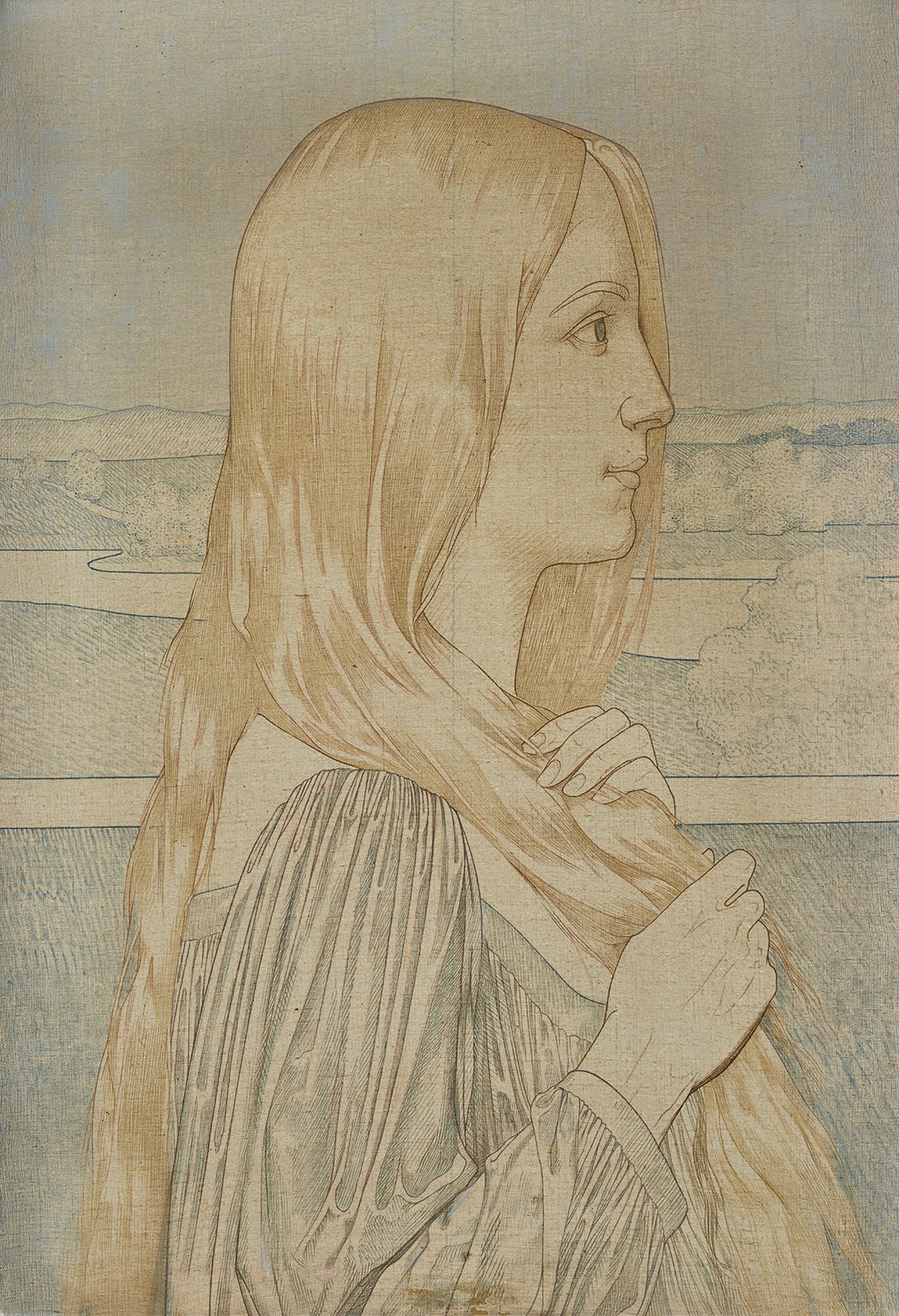
Influenced by the Lyon school, a pupil of Henri Lehmann at the École des Beaux-Arts in Paris, then a disciple of Puvis de Chavannes and close to Georges Seurat, Séon's art is the fruit of a complex training conducive to experimentation. The primacy of line and the question of color symbolism simultaneously nourished his thinking. A great draughtsman and admirer of Ingres, but fascinated by mural art, the artist uses sometimes surprising supports and mediums. This work appears to be unique in his body of work. Séon chose a thin canvas rather than paper to “draw” this characteristic figure of his ideal imagination, in which women are the main motif.
If this stylized, eminently graphic profile refers to other works by the artist, including several sanguines and some important oil paintings, in particular La Pensée (private collection), the option chosen here by Séon reveals several of his obsessions. Derealization, flatness and decorative monumentality define the vision of a painter intent on achieving the ideal. The use of pencils in a very limited range of colors (brown and blue), an extremely subtle hatching system and the fact that the canvas is left in reserve in places, attest to a desire for extreme simplification. By abandoning the pictorial palette, as well as the monochrome of charcoal or red chalk, in favor of a bi-chromatic cameo, Séon seeks, in his usual paradoxical way, to distance himself from the effects of academic and impressionist painting, while at the same time seeking a process that strikes the viewer.
The figure itself combines a hieratic quality due to the perfection of the profile and its immobility, characteristic of the artist's studies on the proportions of face and body, with a kind of youthful intimacy: the model, whose hands hold part of the long, untied hair, is dressed in a gown closer to women's clothing of the time than to the timeless veils or tunics to which Séon usually resorted. If we compare this drawing with La Pensée, whose symbolic pomp is striking, the contrast is striking. The same profile pose, of course, but whereas the oil painting, though strongly colored, achieves a kind of marmoreal solidity, like a polychrome sculpture, the Contemplation, though so stylized and graphic, exudes a quivering humanity. Yet the work is completely anti-realistic. Shades of brown are reserved for the figure and his outfit, while the entire background - a sort of parapet, the landscape with its meadows, clumps of trees and reliefs, and of course the sky - is made up entirely of blue, with only hatching and lines delineating the spaces. This schematization recalls the art of the Nabis or Charles Filiger, for example. But above all, the flatness and chromatic attenuation reveal the legacy of Puvis de Chavannes and the ideal model of the large wall decor for Séon.
His choice of such a singular canvas and technique in this Contemplation is certainly no stranger to the aesthetics of the “fresco”, not in its original practice, since Puvis himself and most of the great decorators of the late 19th century used marouflaged canvas rather than a fresco, but in the spirit of what a monumental decor should be for them.
For Séon, as for Puvis, it's not a question of punching holes in the wall with a perspectivist vision, but of rediscovering the meaning of the symbols of the artists who preceded Alberti and the Renaissance in general. Deprived of public commissions after his work for the Courbevoie Town Hall (1885-1889), Séon, who was nevertheless expecting walls, transferred his love of the plan and of “decorative” and symbolic art in the noblest sense of the term to his easel work, including his graphic work.
Séon also used two-tone planar painting on a number of other occasions, as in the rather large-format Virgin and Child in the Musée d'Orsay, from the collection of Professor Bruno Foucart, which features the blue landscape and a parapet behind the sacred group. The conventional motif of this canvas, of which there is a reduction in the church in the artist's hometown, does not match the subtlety and originality of the drawing in the Flamand-Charbonnier collection.
With its extraordinary technique and enigmatic character, this drawing stands out as one of Séon's most successful works, and as an emblematic image of the idealist symbolism of the 1890s-1900s.
Notice written by Phd Jean-David Jumeau-Lafond
Origin
Remained in the artist's studio until his death in 1917
Fleury Grosmollard (1874-1967), nephew, godson and heir of the artist
Collection Flamand-Charbonnier (Élie-Charles Flamand and Alexandra Charbonnier) : acquired from Fleury Grosmollard around 1965 ;
Private collection, France
Literature
Esthètes et magiciens, symbolistes des collections parisiennes, text by Philippe Jullian, cat. exp, Paris, musée Galliera, 1970, no. 158 (repr.).
Henry Certigny, La vérité sur le Douanier Rousseau - Le conseil municipal Paris, Paris, LaBibliothèque des Arts, 1971, p. 79 (repr.) and 127, note 27.
Jean-David Jumeau-Lafond, “Catalogue des oeuvres exposées”, Alexandre Séon 1855-1917 Labeauté idéale, cat. exp., Quimper, musée des Beaux-Arts, Valence, musée, 2015, Silvana Editoriale, p.206.
Certificate of authenticity issued by Mr Jean-David Jumeau-Lafond on February 10, 2024


75008 Paris, France
Saturdays from 2 to 7 p.m.