

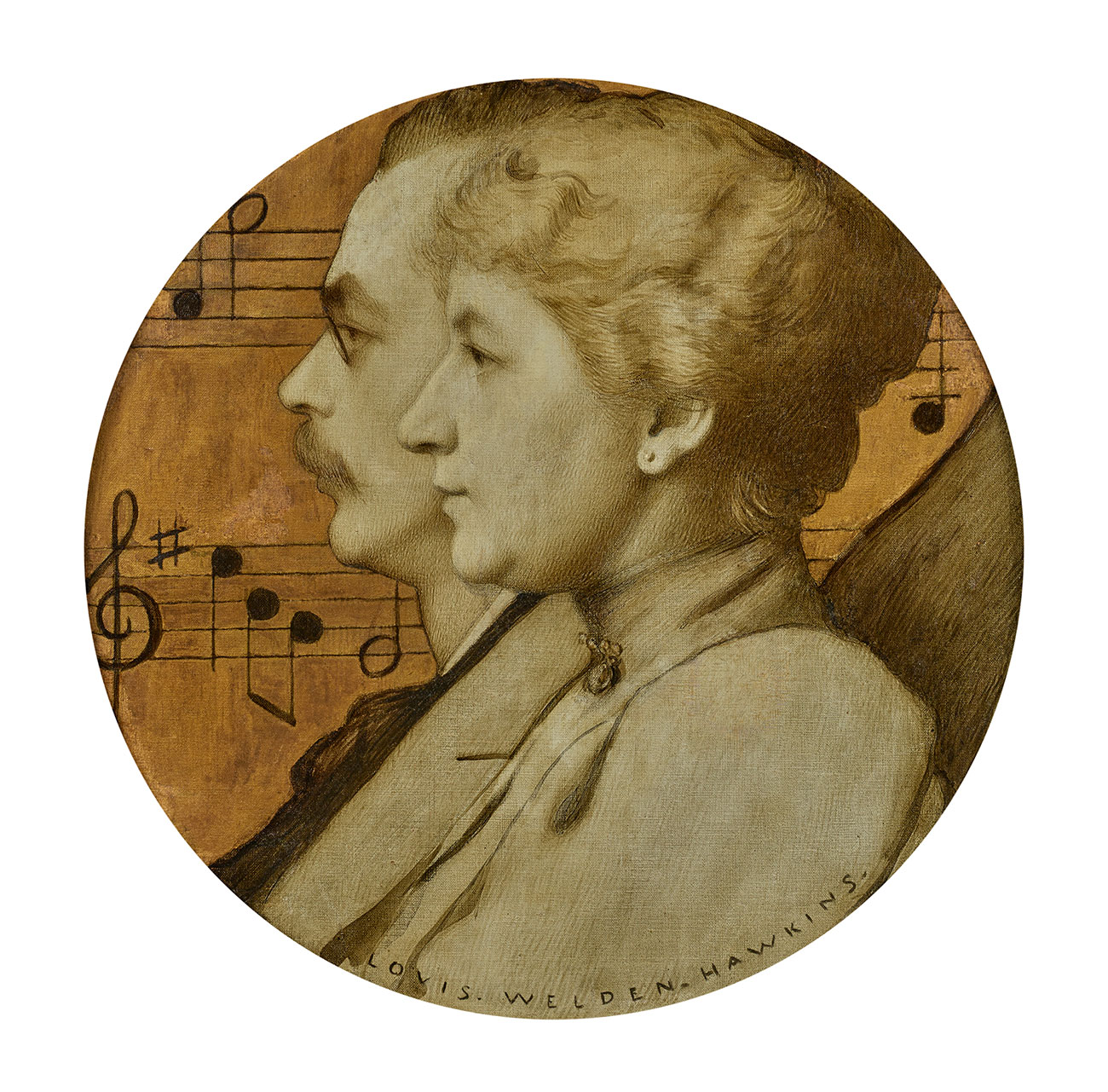
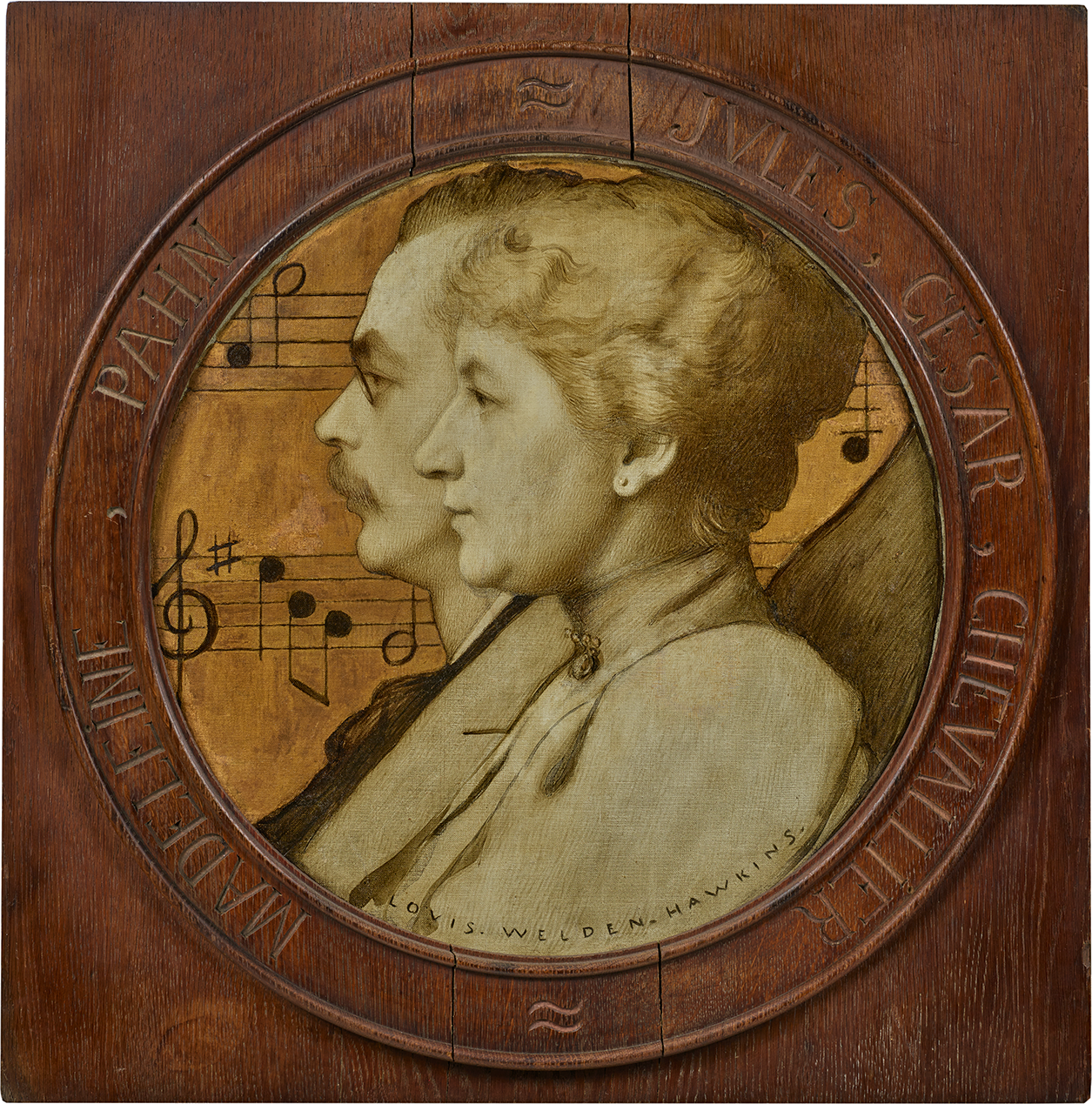
Portraits of Jules Chevallier and Madeleine Pahn


Louis Welden Hawkins
1849-1910
Original frame bearing the carved inscription “Jules César Chevallier - Madeleine Pahn”
Rovigo, Palazzo Roverella, Henri de Toulouse-Lautrec: Parigi 1881–1901 (23 February–30 June 2024), cat. no. IX.12.
Description of the artwork
The singular circular composition presented here belongs to Louis Welden Hawkins’s Symbolist production around 1900, a period during which the artist explored with remarkable subtlety the relationships between portraiture, allegory, and decorative synthesis. Through its medallion format and its original carved frame—bearing the inscription identifying the sitters—the work evokes both the Renaissance tradition of the tondo and the burgeoning Art Nouveau aesthetic of the time.
The two figures, identified as the composer Jules César Chevallier (1866–1923) and his wife Madeleine Pahn, are rendered in strict profile, following a formula inspired by antique medals and Renaissance effigies. Modelled in grisaille, their faces stand out crisply against a luminous gold ground animated by musical staves. This interplay between the naturalistic precision of the features and the decorative abstraction of the background fully embodies Hawkins’s Symbolist aesthetic.
Though somewhat forgotten today, Jules Chevallier enjoyed a measure of recognition in his lifetime. A composer of songs and operettas, he is notably the author of Le Marchand de sable (1901), set to a text by Tristan Klingsor, a poet associated with Symbolist circles. Together with his wife, he directed a music school on the rue d’Offémont in Paris, and from 1899 onward led an opera staging course alongside the actor Fernand Dupas. In 1901, the Montmartre composer Gabriel Fabre dedicated a new edition of his Sonatines sentimentales to Madeleine Chevallier, further attesting to the couple’s artistic standing.
Here Hawkins transcends the conventions of society portraiture to offer an idealised vision of conjugal and creative union. The husband, set slightly behind, is depicted with firmly defined features, while the female figure in the foreground is distinguished by the softness of her modelling and the delicacy of her expression. The deliberately restrained palette—pale flesh tones set against the radiant gold ground—recalls the Italian Primitives, while the smooth, carefully blended surface reflects the artist’s rigorous academic training. Yet the simplification of volumes and the stylised, cloisonné-like contours reveal his engagement with the synthetic tendencies of Symbolism, particularly under the influence of Puvis de Chavannes.
Far from serving as mere decorative motifs, the musical staves endow the image with a spiritual dimension: they evoke not only harmony of sound but harmony of souls. The circular format, the union of the profiles, and the carved inscription of the frame together transform the painting into a veritable painted medal, in which intimate memory is elevated to the dignity of symbol. Through the masterful equilibrium of its composition, Hawkins thus proposes a timeless image of resonance and concord, situating his sitters within a sphere at once artistic and ideal.
Origin
Former Robert Tschoudoujney collection
Private collection, France
Literature
Jumeau-Lafond, Jean-David, Parisi, Francesco (eds.), exhibition catalogue ‘Henri de Toulouse-Lautrec: Parigi 1881-1901’ (Rovigo, Palazzo Roverella, 23 February – 30 June 2024), Milan, Dario Cimorelli editore, 2024, reproduced on p. 242, described on p. 343.
Artworks to discover


75008 Paris, France
Saturdays from 2 to 7 p.m.