

Presumed portrait of Martial Deveaux




William Bouguereau
1825-1905
Signed lower left with the monogram '1854 WB'
Description of the artwork
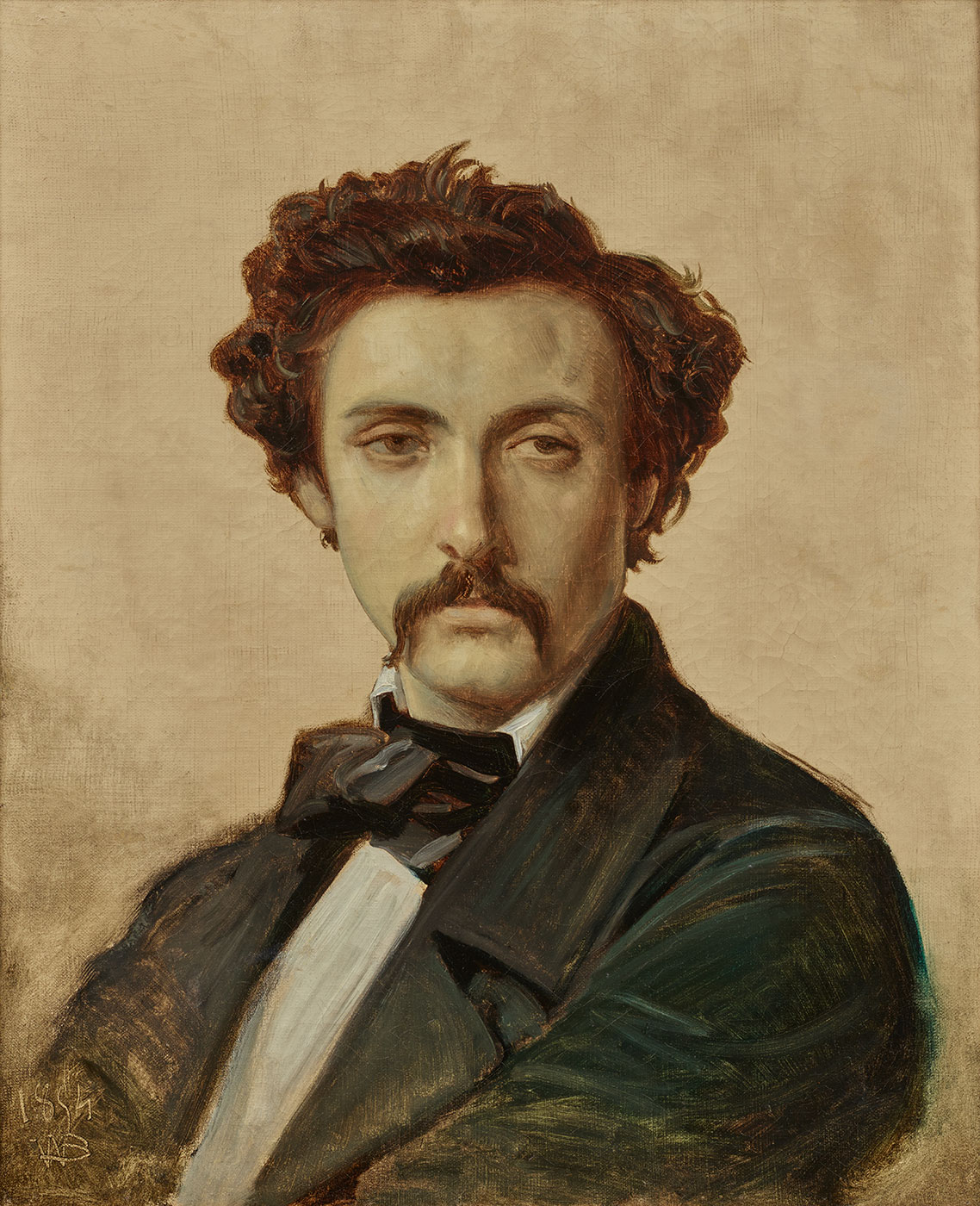
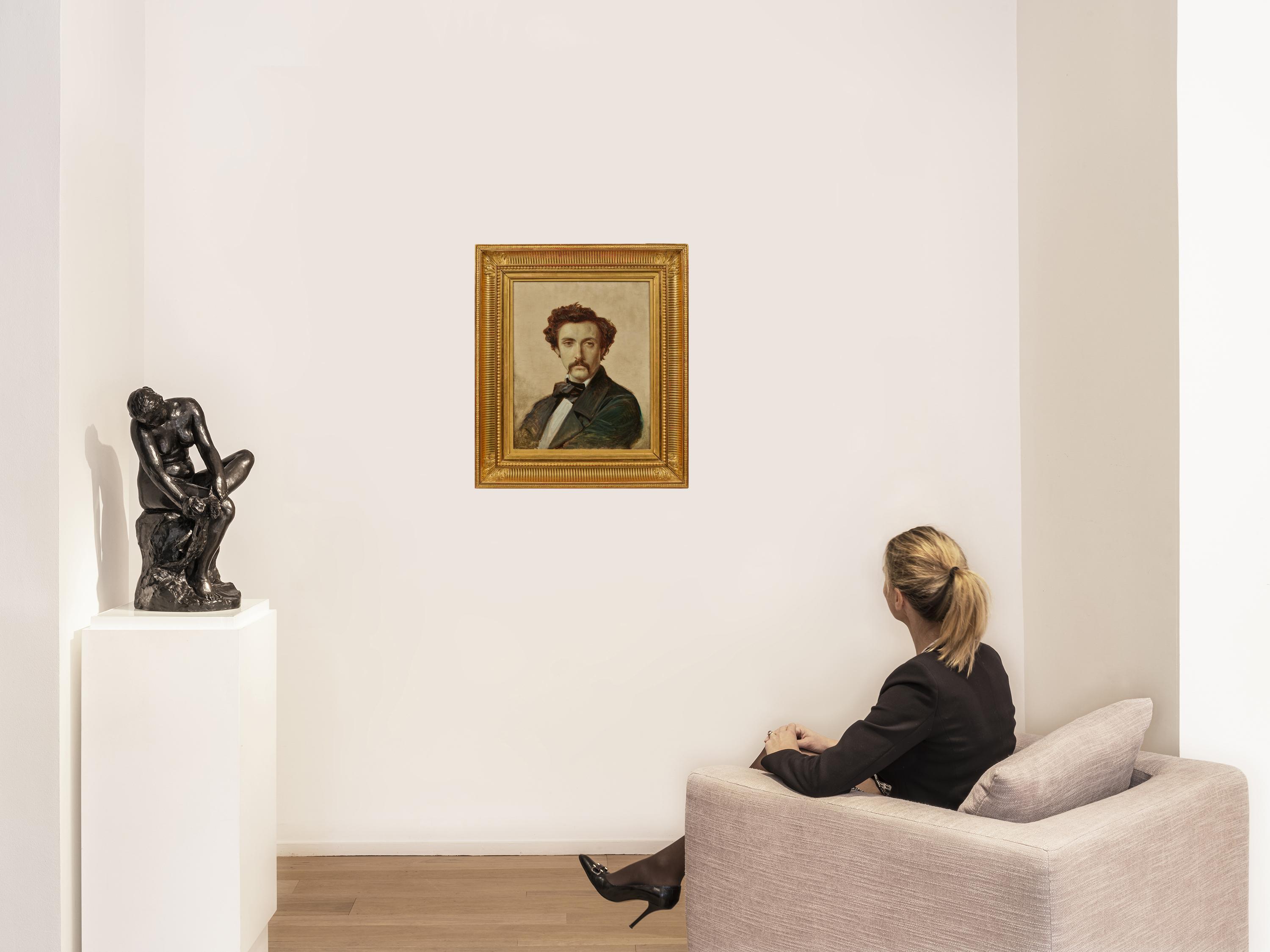
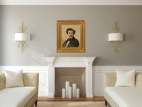
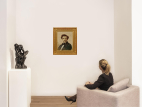
Precisely dated 1854, the sober and penetrating portrait of a man that we present was most likely executed as William Bouguereau was completing his stay at the Villa Medici, where he had resided for more than three years as a laureate of the Prix de Rome.
The sitter is depicted in bust, slightly turned to the right, his gaze somewhat distant, in an almost meditative attitude. The restrained pose, devoid of any display, lends the portrait an intimate and fraternal dimension. While the modeling of the face, of great softness, attests to the assimilation of the lessons learned in Rome and to a careful study of the Renaissance masters, the physiognomy—an open forehead and a full, carefully structured moustache—appears rendered with a brush attentively faithful to the truth of the features.
Bouguereau here adopts a deliberately restricted palette in an elegant grisaille, composed of black, white, and various tonalities of grey. The deep blacks of the jacket and bow contrast with the luminous white of the shirt. Likewise, the dense, wavy hair and dark moustache stand out against the naturally fair complexion of the face. The light, diffuse and balanced, models the forms without theatrical effects, already revealing the young painter’s complete technical mastery. The choice of a neutral background, animated only by a subtle and very modern grey gradient rising from bottom to top, concentrates all attention on the psychological presence of the sitter.
Our portrait very probably represents the engraver Jacques-Martial Deveaux, also a resident of the Académie de France in Rome, with whom the artist then shared the studious daily life and intellectual emulation characteristic of the institution (fig. 1). While Bouguereau was completing one of his most important submissions, The Triumph of Martyrdom, which would earn him great success at the Exposition Universelle of 1855, he was commissioned to paint the portrait of his fellow student to adorn the dining room of the Villa Medici. Painted, according to the artist’s journal, between 30 October and 20 December 1853, the painting depicts the engraver in a three-quarter bust (fig. 2). Several morphological elements correspond strikingly with our portrait: beyond the thick, drooping moustache, the structure of the face—the broad forehead, high cheekbones, narrower chin, and straight, fine nose—appears identical.
Like Bouguereau, Deveaux likely extended his stay in Rome for a few months at the beginning of 1854, the date of execution of our portrait. It seems that the painter wished to present a more sincere image than in the more conventional version painted for the Villa Medici, granting his sitter greater expression through a quicker, freer, and more spirited handling, and through a more frontal composition reminiscent of the self-portrait he painted the same year (fig. 3).
Today little known, Jacques-Martial Deveaux (1825–1916) was a highly regarded burin engraver. Upon his return to Paris, he accumulated numerous official distinctions, receiving a first medal at the Salon in 1864, before winning a second-class medal at the Exposition Universelle of 1878, and both a first-class medal and a silver medal at the Exposition Universelle of 1889. Far removed from the large historical compositions that occupied the pensionnaires of the Academy, this striking portrait, which remained in Bouguereau’s studio until his death, appears as a more intimate exercise, imbued with memory and affection.
Origin
Artist's family
Private collection, Normandy
Artworks to discover



75008 Paris, France
Saturdays from 2 to 7 p.m.