

Tales of the 1001 Nights


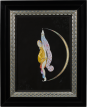

Romain De Tirtoff dit Erté
1892-1990
Titled and numbered on the back 1.288.
Circa 1928
Description of the artwork
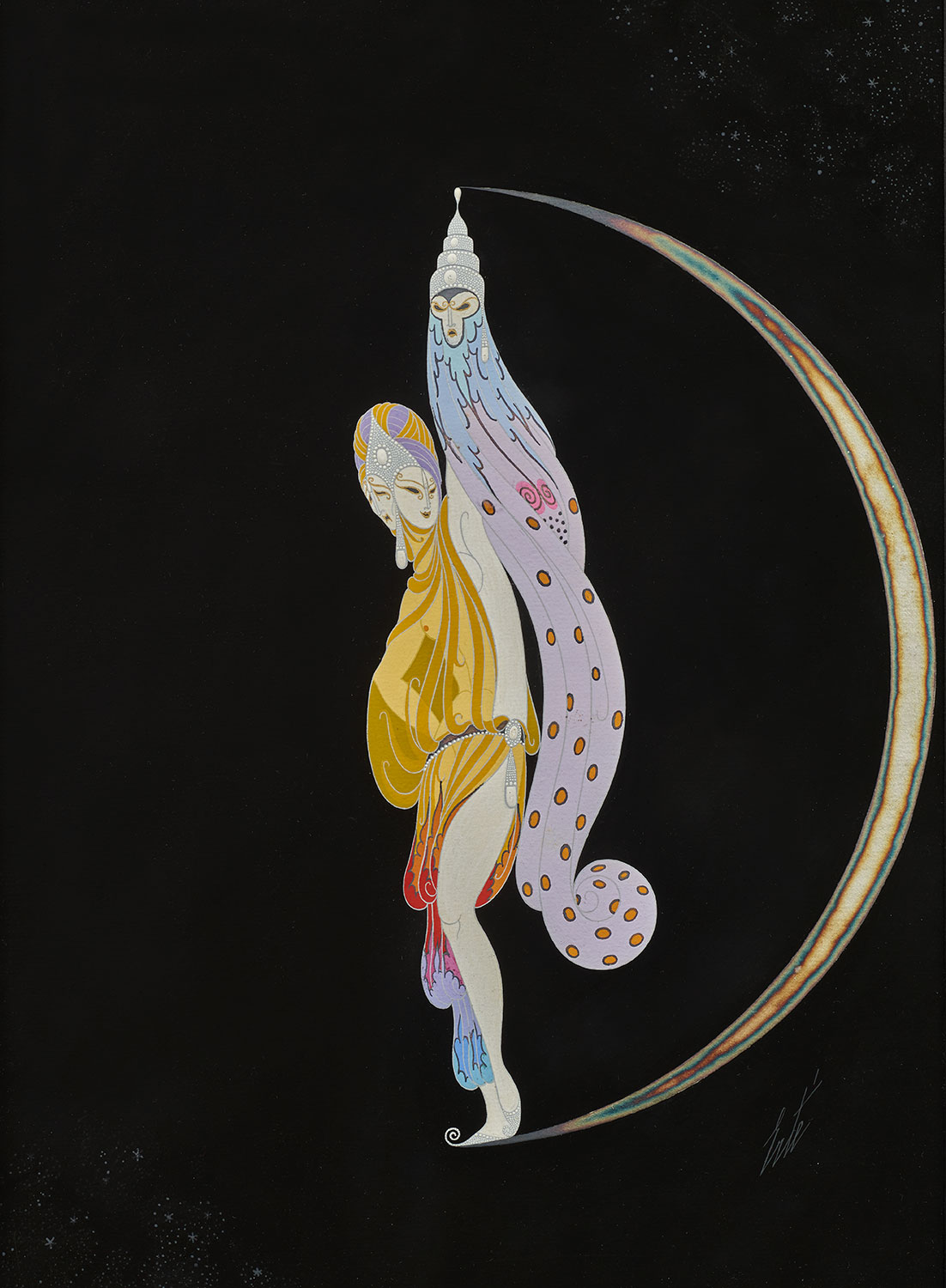
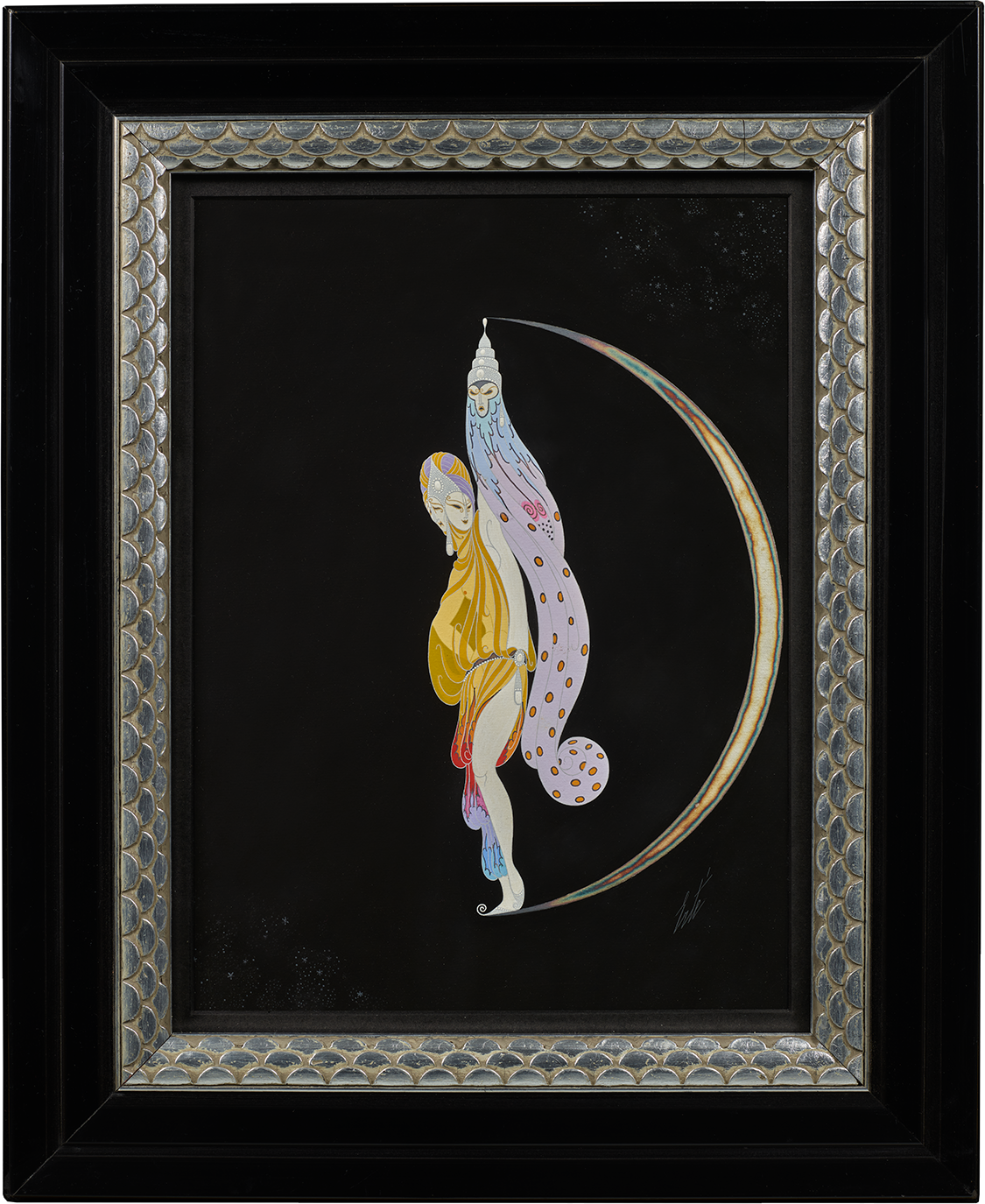
Executed around 1928, this gouache belongs to one of the most prolific periods of Erté’s career, when he was closely associated with the worlds of theatre and music hall. The title inscribed on the reverse,The Tales of the Thousand and One Nights, links the composition to the realm of fantasy and enchantment that inspired a significant part of his work during the late 1920s.
Against the depth of a black, star-studded background stands a female figure draped in golden yellow. Her elongated body overlaps with a strange creature in shades of mauve and blue, whose sinuous form follows the figure before visually extending into the immense crescent moon that structures the composition. Figure, costume and setting thus seem to merge into a single apparition. For Erté, the human body becomes the starting point for a graphic invention in which the costume undergoes a metamorphosis, extending beyond the silhouette to become an integral part of the theatrical effect.
This approach is characteristic of Erté’s costume designs of the 1920s. The fluid, continuous line, elongated proportions, areas of rich colour and meticulous refinement of the ornamentation exemplify the Art Deco vocabulary developed by the artist. Erté was particularly drawn to such transformations, in which feathers, plants, animals and celestial elements become extensions of the human body. Here, the crescent moon and starry sky lend the figure an almost otherworldly quality, naturally placing the composition within the enchanted universe evoked by its title.
The dating of the work also invites comparison with an important group of designs created by Erté for Aladdin and His Wonderful Lamp at the Folies Bergère. The Bibliothèque nationale de France holds several costume designs produced for this show and dated 1928 or 1929, including Scheherazade,The Sultan,The Jades and Two-Thousand-Year-Old Eggs. Its collections also include designs for the sets ofAladdin’s Palace and the Curtain for the Love Scene, demonstrating the extent of Erté’s contribution to this production.
The title The Tales of the Thousand and One Nights, inscribed on the present sheet, therefore takes on particular significance. Although it does not allow this gouache to be identified with certainty as a design intended for Aladdin and His Wonderful Lamp, its date, iconography and formal vocabulary place it firmly within Erté’s exploration of an enchanted Oriental world during the same period. Other documented costume designs for Aladdin further attest to the extraordinary variety of characters and inventions devised by the artist for this production.
Through the spectacular fusion of the female figure, the fantastical creature and the crescent moon, The Tales of the Thousand and One Nights fully embodies Erté’s distinctive conception of costume: no longer simply a garment, but a complete silhouette, designed to transform the performer’s body into a theatrical apparition. At the same time, the precision of the gouache and the carefully balanced composition give the work the autonomy of a graphic artwork in its own right, at the intersection of fashion, decorative arts and the stage.
Artworks to discover



75008 Paris, France
Saturdays from 2 to 7 p.m.