

The acrobat


Marc Chagall
1887-1985
Signed lower right
Tokyo, Nihonbashi Takashimaya Gallery, “Homage to Chagall”, 1986
Description of the artwork
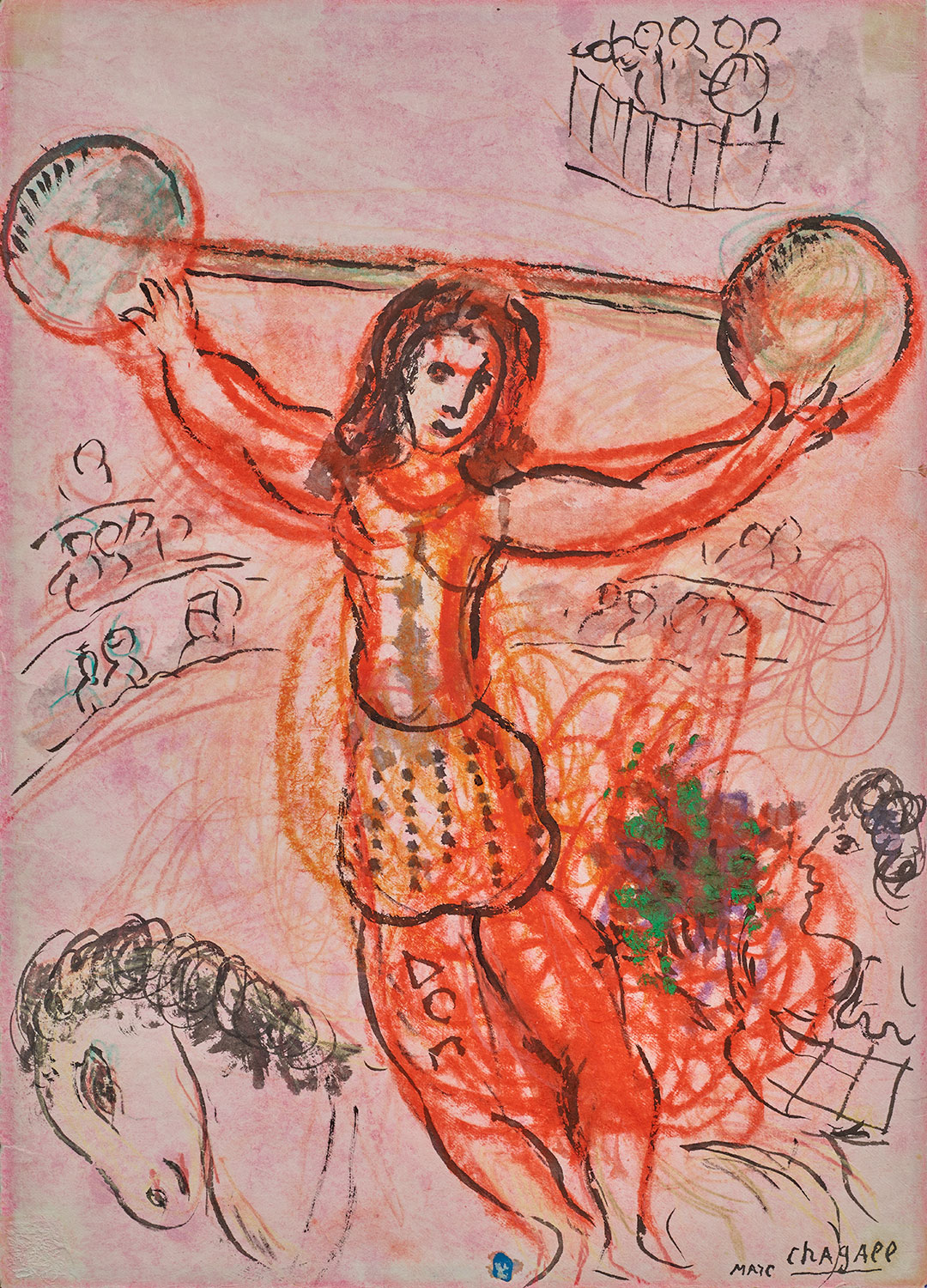
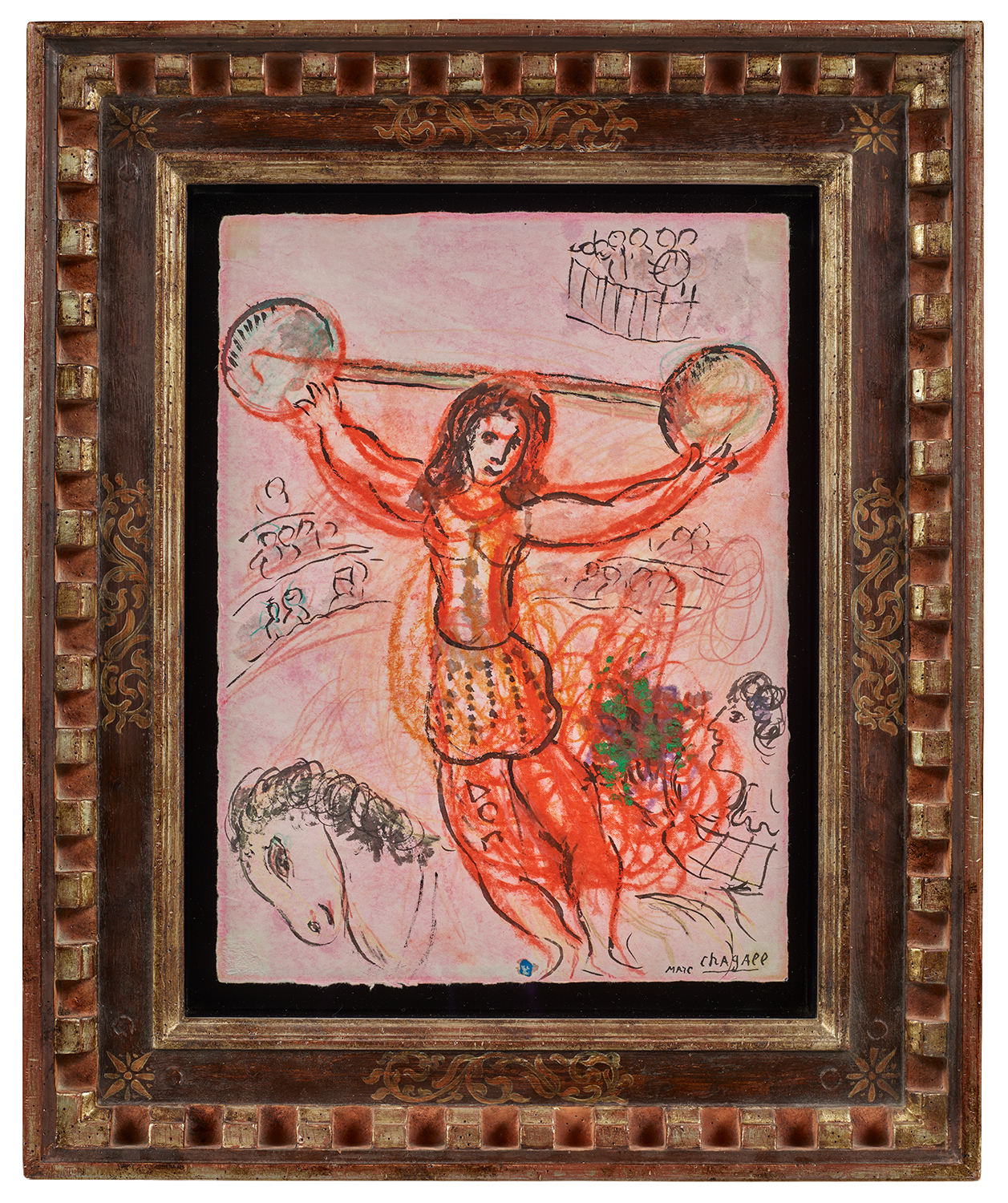
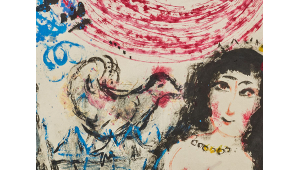
Produced around 1963-1964, this work belongs to a particularly fruitful period in Marc Chagall's career, marked by the completion of the ceiling of the Opéra Garnier in Paris and by a renewal of his interest in the themes of the circus, spectacle and music. The artist's plastic vocabulary then achieves a remarkable freedom: the drawing, with an almost calligraphic spontaneity, dialogues with flat areas of gouache, pastel and colored pencils in a writing where the apparent improvisation masks perfect mastery.
In the center of the composition, a young acrobat with widely outstretched arms lifts two discs which evoke both circus apparatus and luminous stars. Its body, painted in a dominant of flamboyant reds and oranges, radiates the entire leaf. Around her revolve several sketched figures: spectators installed in the stands, bouquet of flowers, female face and horse's head. These motifs, familiar from Chagall's universe, do not constitute a story in the traditional sense but a network of poetic associations where memory, dream and reality merge. The horse, symbol of freedom and vitality, dialogues with the flowers, a recurring evocation of love and celebration, while the circus ring becomes a suspended space between the terrestrial world and the imagination.
The theme of the circus accompanies Chagall throughout his existence. Born from the traveling shows discovered in his childhood in Vitebsk then nourished by his visits to the Cirque Medrano in Paris, it became for him a true metaphor of the human condition. Behind the apparent lightness of the acrobats and clowns, the artist perceives the fragility of existence, the precarious balance between joy and melancholy. Chagall himself wrote that the circus was “the representation which seems to him the most tragic”, while seeing it as a place where poetry allows one to transcend reality.
Through its free execution, its incandescent chromatism and the evocative power of its symbols, this sheet fully illustrates the plastic language of Chagall in the 1960s. More than a simple performance scene, it offers a deeply lyrical vision where the acrobat seems to rise above the ring to become a universal figure of grace, freedom and hope.
Origin
Artist's studio
Sale, London, Christie's, 8 February 2007, lot 719
Private collection, Switzerland
Sale, Tokyo, Mainichi Auction, 7 November 2015, lot 324
Literature
The authenticity of this work has been confirmed by the Marc Chagall Committee
Artworks to discover


75008 Paris, France
Saturdays from 2 to 7 p.m.