

The duet


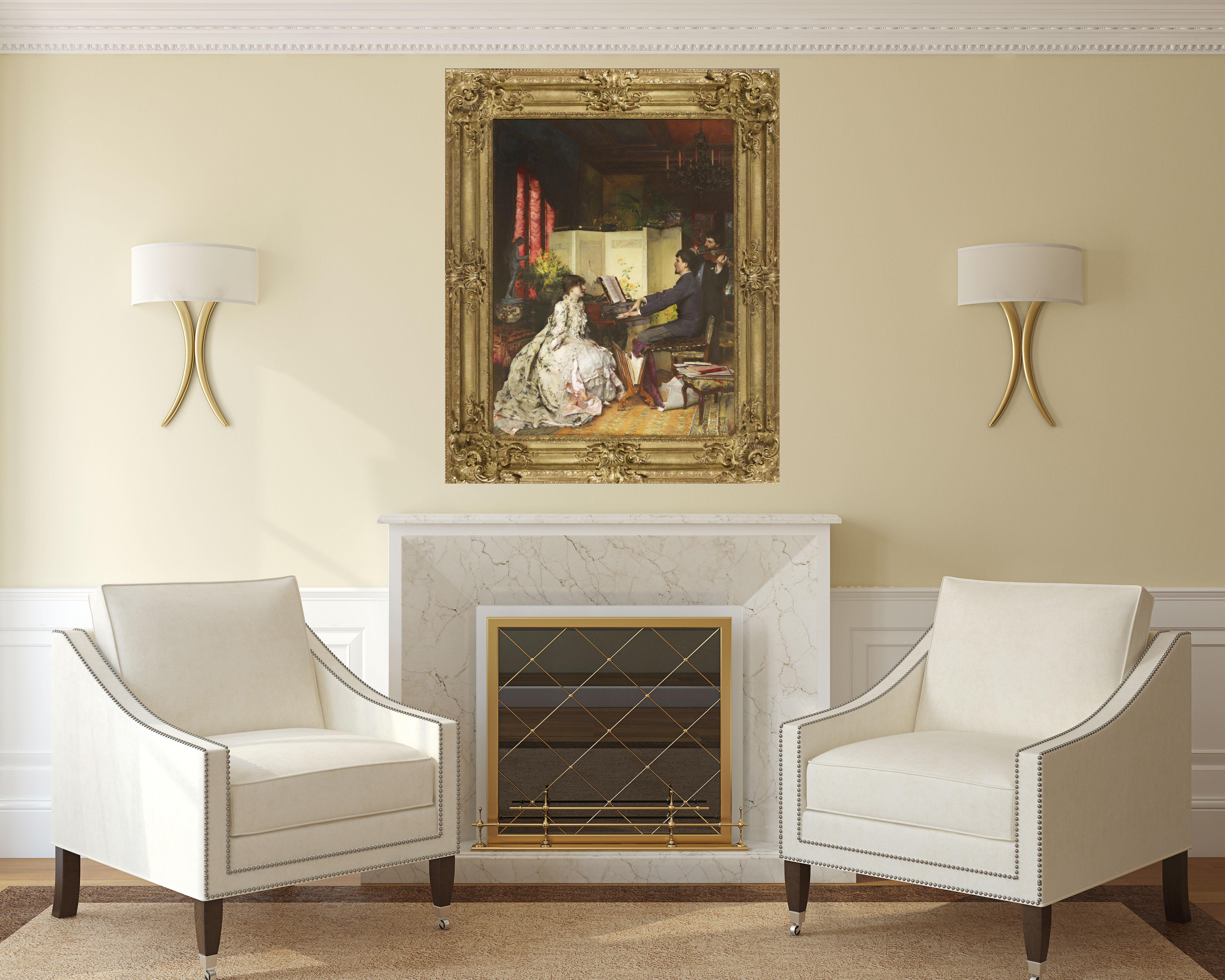
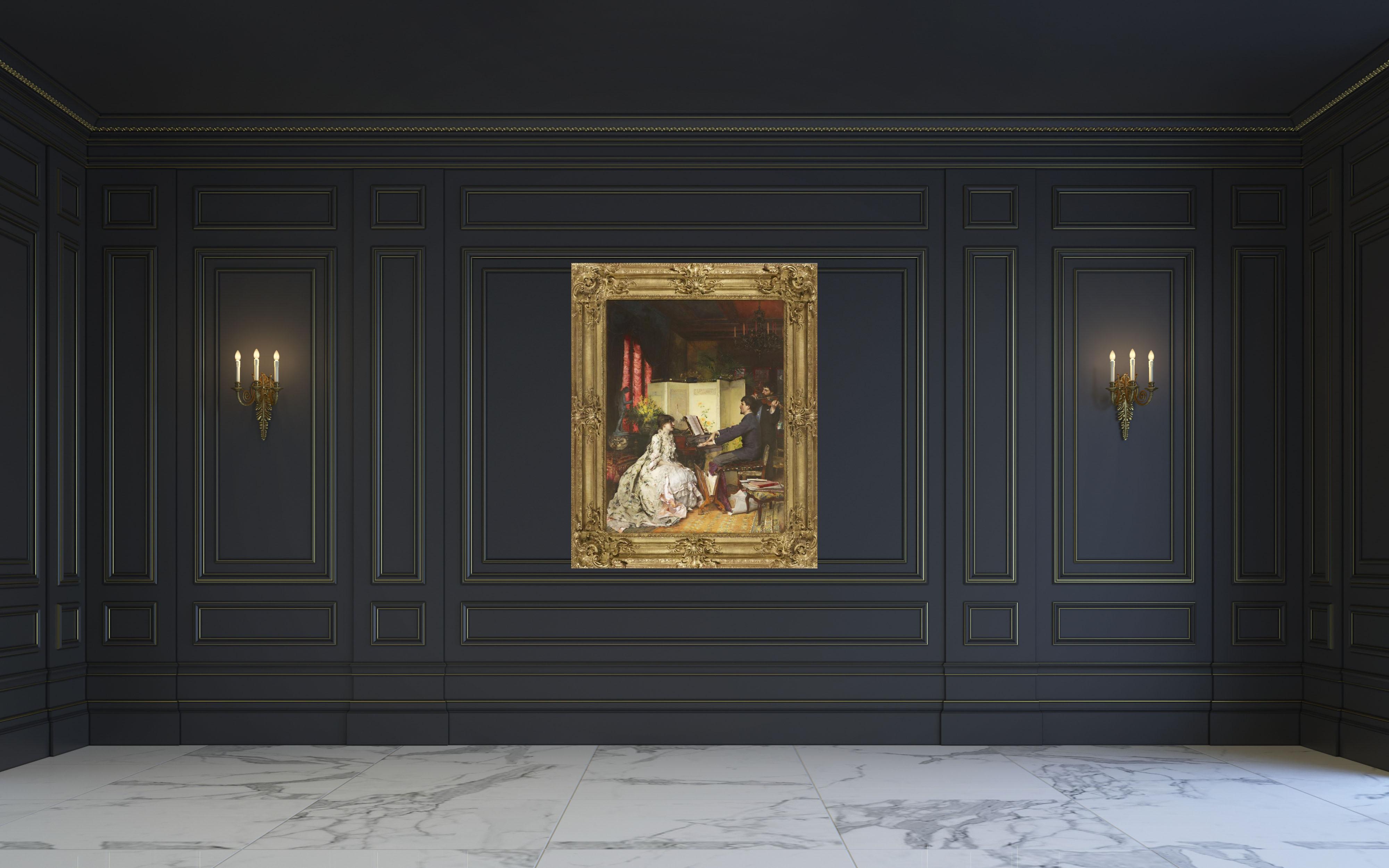

Pascal Dagnan-Bouveret
1852-1929
Art Institute of Chicago, Works of P.A. Dagnan-Bouveret: A Loan Exhibition, March 1-24, 1901, no. 8 (lent by Thomas E. Waggaman)
Exhibition "Tentations. L'appel des sens" Paul Dini Museum, Villefranche from 16 October 2016 to 14 February 2017
Exhibition « La mode du XVIIIe siècle, un héritage fantasmé », Palais Galliera, Paris, 2026
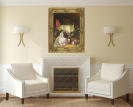
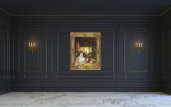
Description of the artwork
The painting is signed ‘P.A.J. DAGNAN-B.’: the ‘J’ cannot be mistaken for an ‘S’, as in later signatures which have been read as ‘PAS’ and interpreted as an abbreviation of Pascal, although this was not the artist’s usual first name. We have few sources regarding this painting, which was produced in 1883, a year in which Dagnan-Bouveret did not exhibit at the Salon and was not yet prolific in his correspondence. However, we do know the context in which it was created.
In late 1880, Dagnan-Bouveret and his friend, the painter Gustave Courtois, rented a double studio on the first floor of 147 Avenue de Villiers, near the Porte de Champerret, in a newly built building with large glass-fronted windows. Dagnan-Bouveret had married a cousin of Courtois’s in late 1879.
While on summer holiday with his in-laws in Corre, in Haute-Saône, he painted scenes of life in the Franche-Comté region. He spent the winter in the capital and depicted scenes of Parisian life: *Bouderie* (1880), *Au Louvre* (or *Aquarelliste au Louvre*, 1881, Saint Petersburg, Hermitage Museum; ill. 1, p. 123), Jeune femme en rose avec son enfant (1882). It is to this series that Le Duo belongs, the title under which the painting was listed (The Duet) at the sale of the Seney collection in New York in 1885. In the catalogue of works compiled in 1930 by the painter’s heirs, it is listed under a generic title: Music.
The early 1880s on Avenue de Villiers appear to have been a period of great excitement and burgeoning talent, in a joyful and festive atmosphere shared with the other artists living in the building, notably the Finnish artist Albert Edelfelt. At that time, these painters in their thirties, pupils of Jean-Léon Gérôme, were in the habit of posing for one another to avoid having to pay models.
This is how the pianist can be identified: he is the Bavarian painter Carl von Stetten. His profile and hairstyle are identical to those of the hero in The Martyrdom of Saint Maurice (1886, Pusey Church, Haute-Saône), a painting for which he also posed in profile for his friend, Gustave Courtois. The model for the young woman is most likely Antonia Bonjean, a painter who exhibited at the Salon and posed for Edelfelt and his Finnish colleague Gunnar Berndtson (notably in Lady in Black with Pink Roses, 1879, private collection). The violinist may be another young painter: he appears in 1884 as a piano teacher keenly interested in his pupil in a painting by Edelfelt, At the Piano (1884, Gothenburg, Museum of Fine Arts).
Although the young woman wears a period costume that might suggest she is an opera singer, her demeanour suggests she is more likely an audience member listening to the duet. Her 18th-century-style French dress, with flat pleats and a jabot, is made of textured fabric, lined with pink satin.
The arrangement of the lace around the neck and along the front panels, and the puffed, ribbon-trimmed skirt, suggest a design made in the 1880s from a fabric with a rocaille pattern; it is difficult to determine whether this fabric dates from the 18th century or was woven in the Louis XV style at that time. This dress may have been borrowed from a theatre or from a painter’s costume collection: it was not until the late 1890s that Dagnan-Bouveret called upon his close friend, the couturier Jean-Philippe Worth, to dress the ‘clients’ he was painting.
- Brice Leibundgut
p.156, catalogue of the exhibition ‘18th-century fashion, a fantasised heritage’, Palais Galliera, Paris, 2026.
Origin
Goupil & Cie, Paris, no. 16879 (acquired directly from the artist, December 1883)
Knoedler & Co., New York, no. 4555 (acquired from the above, January 1884)
George Ingraham Seney, Brooklyn, New York (acquired from the above in February 1884 and sold, his sale, American Art Association, New York, March 31, 1885, lot 88)
Thomas E. Waggaman, Washington, D.C. (and sold, American Art Association, New York, January 25, 1905, lot 80, illustrated, as A Duet in the Studio)
J. Schmitt (acquired at the above sale)
Private Collection, France
Literature
Authenticity confirmed by Dr. Gabriel P. Weisberg
"Artistic Costumes in the late Seney Collection," Demorest's Monthly Magazine, New York, June 1885, p. 528
L.E. Van Zandt, "The Waggaman Collection," The Art Interchange: An Illustrated Guide for Art Amateurs and Students, with Hints on Artistic Decoration, New York, June 1894, vol. XXXII, no. 6, p. 160
"The Waggaman Art Galleries: A Rare Collection In Danger of Dispersion," The Booklovers Magazine, Philadelphia, November 1904, vol IV, no. 5, p. 618 (as A Duet in the Studio)
Exhibition catalogue « La mode du XVIIIe siècle, un héritage fantasmé », Palais Galliera, Paris, 2026 - illustrated p.157
Artworks to discover




75008 Paris, France
Saturdays from 2 to 7 p.m.