

The Numismatist's cabinet



Hugo Charlemont
1850-1939
Description of the artwork
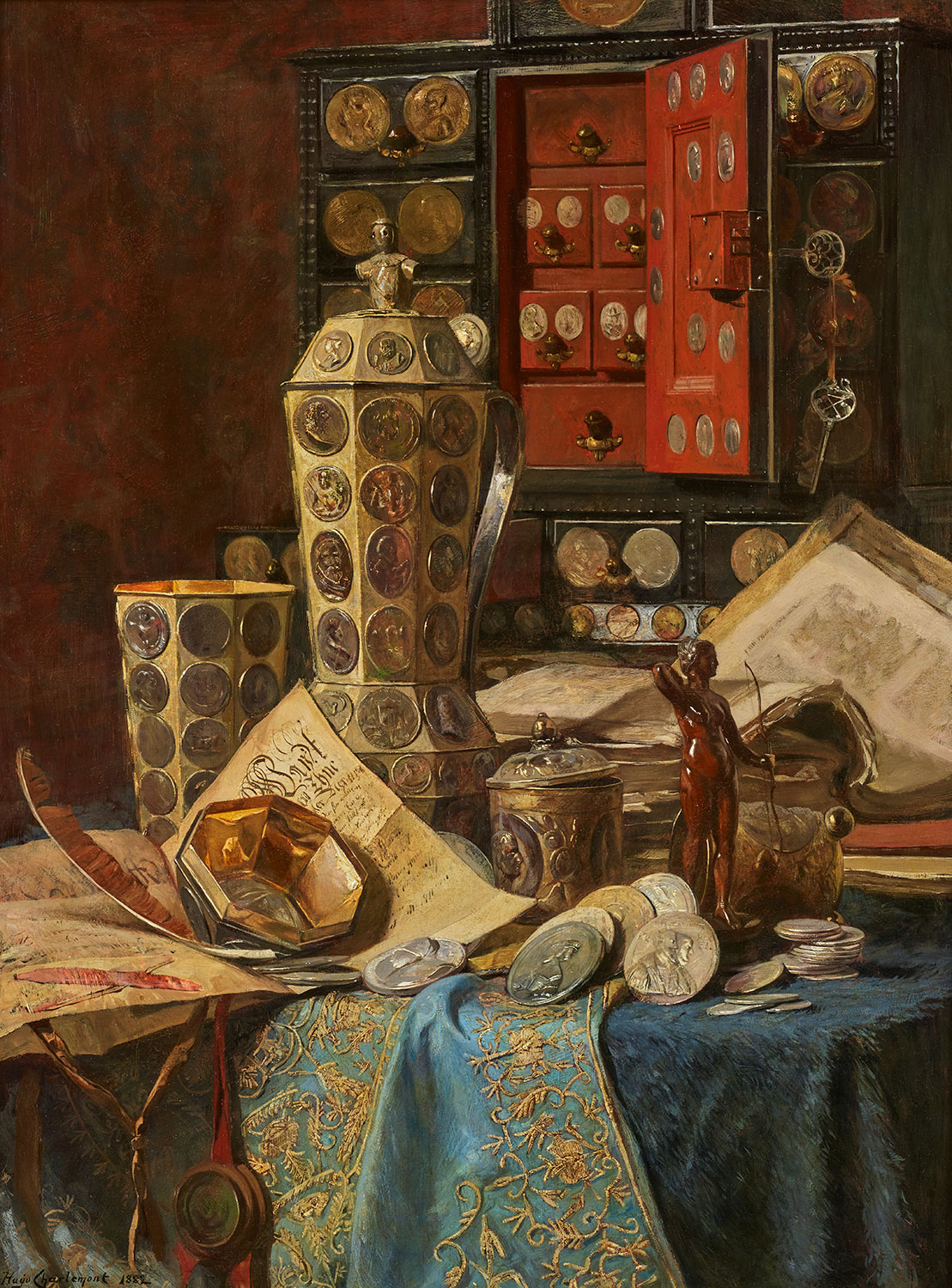
Dating from 1882, the oil on panel we are presenting here is one of Hugo Charlemont's more intimate works. Part of the tradition of scholarly still life, it reveals the young artist's technical and intellectual ambitions by transporting us into the study of a 17th-century numismatist.
The composition unfolds vertically, organised in front of a medal cabinet whose half-open door reveals a series of compartmentalised drawers. Each surface, each drawer, each piece of woodwork is studded with carefully arranged ancient coins. In the foreground, a table covered with a rich blue embroidered cloth is strewn with a profusion of objects: medals and silver coins bearing imperial effigies are clustered around silver containers, open manuscripts and old papers finely calligraphied. The palette is dominated by warm tones (deep browns, lacquered reds, muted golds) which give the whole a hushed, almost monastic atmosphere. The side lighting, coming from the left, catches the reliefs of the coins and makes their profiles sparkle, as if suggesting a silent dialogue. The metallic reflections are rendered with illusionist precision, while the embroidered fabrics vibrate with a more subdued brilliance. Charlemont excels in the contrast of materials: the cold metal of the coins contrasts with the softness of the textiles and the ivory whiteness of the old paper.
The diagonals formed by the manuscript pages draw the eye towards the centre of the painting, where a large polygonal ceremonial jug, transformed into a numismatic mount, takes pride of place. Set with a base and lid decorated with medals and ancient coins, just like the large goblet that accompanies it, it resembles a Renaissance trophy or hanap. This unusual use of coins to decorate silver objects was common among goldsmiths in Brandenburg-Prussia from the mid-17th century onwards, and was particularly popular among those in Berlin and Königsberg.
At the foot of this precious tankard is an unsealed letter on which rests the lid of the goblet and a pen left there incidentally, as if to emphasise the erudition of the owner of these treasures. Finally, the painter has taken care to place an elegant patinated bronze statuette of Diana the Huntress on the right-hand side of the table. The presence of this small antique sculpture, reaching with her right hand for an arrow in her quiver, introduces a discreet allegory. Indeed, in this cabinet, the goddess of the hunt seems to inevitably refer to the numismatist's relentless quest, for just as the latter hunts for rare coins, so every hunter pursues his prey.
Artworks to discover






75008 Paris, France
Saturdays from 2 to 7 p.m.