

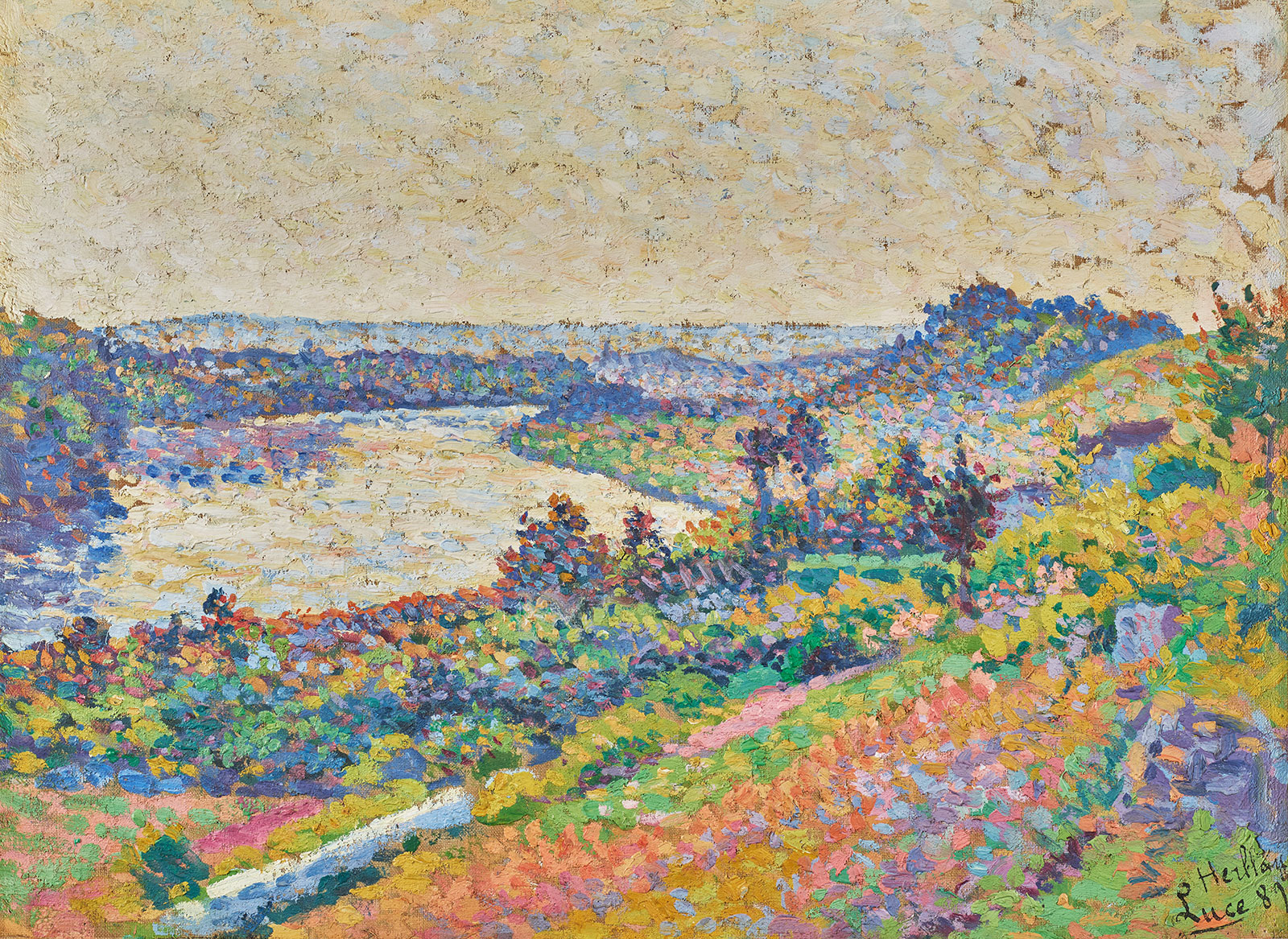
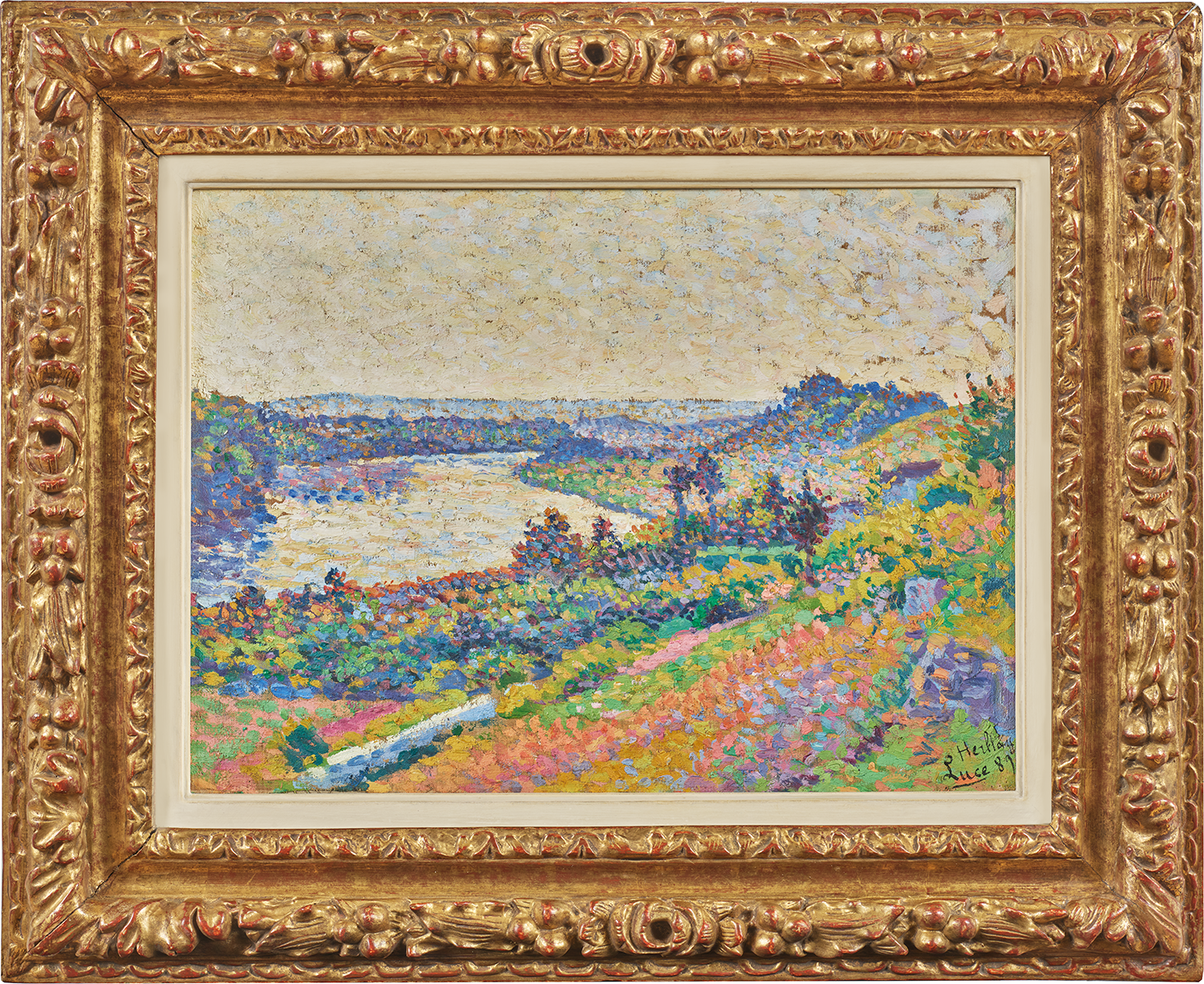
The Seine at Herblay, 1889


Maximilien Luce
1858-1941
Maximilien Luce, l’instinct du paysage, Paris, Musée de Montmartre (21 March – 14 September 2025), cat. no. 46: ‘La Seine à Herblay, 1889’.
Description of the artwork
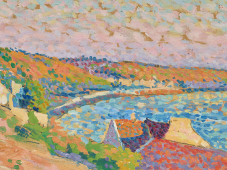
Painted in 1889, our small oil on board depicting The Seine at Herblay offers a striking testimony to the artistic investigations pursued by Maximilien Luce in the wake of Neo-Impressionism at the end of the 1880s. Invited by his friend Signac to Herblay to paint directly from nature (fig. 1), the artist positions himself on the heights to embrace a panoramic view of the Seine valley, whose broad course winds through the heart of a luminous and gently undulating landscape.
The composition unfolds in successive planes that naturally guide the viewer’s eye toward the horizon. In the foreground, the colorful slope of the hillside, rendered through a mosaic of vivid touches—acid greens, luminous yellows, pinks, and violets—evokes the rich vegetation of the terrain.
A few trees and bushes punctuate the slope and structure the space, while a pale path introduces a soft diagonal that animates the surface of the painting. Further on, the Seine spreads out in a bright, shimmering expanse whose pale reflections contrast with the colored masses of the wooded banks. The hills and villages of the valley dissolve into a range of blues and violets, lending the whole a subtle atmospheric depth. Above, the sky occupies a large portion of the composition: treated with light touches combining whites, ochres, and blues, it diffuses a gentle light that envelops the entire landscape.
The fragmented brushstroke, characteristic of Neo-Impressionist practice, gives the surface a constant vibration. Seen up close, the painting appears as an assembly of nearly abstract colored touches; from a distance, they recombine into a coherent and luminous vision.
Through this process, Luce seeks less to describe the motif precisely than to convey the chromatic intensity and luminous sensation of the observed landscape, which he later reworked in the studio into a larger composition now preserved at the Musée d’Orsay (fig. 2). The finished canvas, exhibited the following year at the Durand-Ruel Gallery[1], and later at Le Barc de Boutteville in 1893[2], met with considerable success.
Recently rediscovered and exhibited during the artist’s latest retrospective at the Musée de Montmartre in Paris, our small preparatory panel constitutes an essential milestone and one of the earliest testimonies to Luce’s assimilation of the Divisionist principles of Neo-Impressionism. The freedom of the brushwork, the poetic boldness of the color, and the simplicity of the motif express one of the young painter’s central concerns: capturing, through painting, the luminous vibration and silent life of nature—confirming the praise of Félix Fénéon: “Luce’s landscapes luxuriate in active atmospheres.”[3]
[1] Deuxième exposition des peintres graveurs, Paris, Galerie Durand-Ruel, 1890, cat. no. 178.
[2] Cinquième exposition des peintres impressionniste et symboliste, Paris, Galerie Le Barc de Boutteville, 1893, cat. no. 116.
[3] Félix Fénéon, “Extrait d’Au Pavillon de Paris,” Le Chat Noir, 2 April 1892.
Literature
To be compared with the painting titled Herblay, oil on board, signed lower left and measuring 25.5 x 23 cm, reproduced p. 22 as no. 61 in the Catalogue de l'œuvre peint, tome II, by Jean Bouin-LUCE and Denise BAZETOUX, Éditions JBL, Paris, 1996.
Paquet, Jeanne, Legé, Alice S. (eds.), exhibition catalogue Maximilien Luce, l’instinct du paysage, Paris, Musée de Montmartre (21 March–14 September 2025), Paris, Éditions El Viso, p. 14, reproduced on p. 128.
Artworks to discover


75008 Paris, France
Saturdays from 2 to 7 p.m.