

Washerwomen and landscape




Auguste Renoir
1841-1919
1916
Description of the artwork
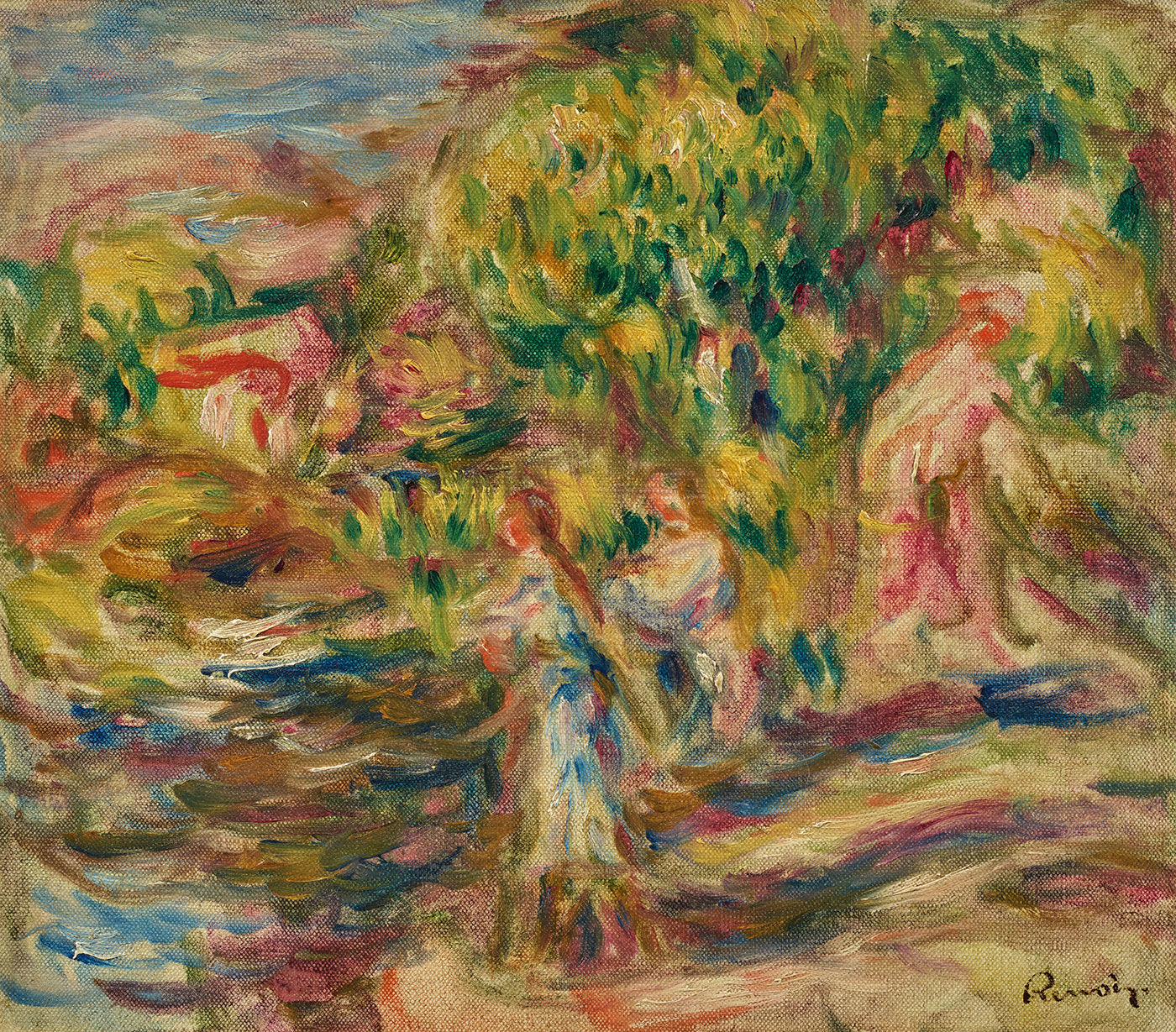
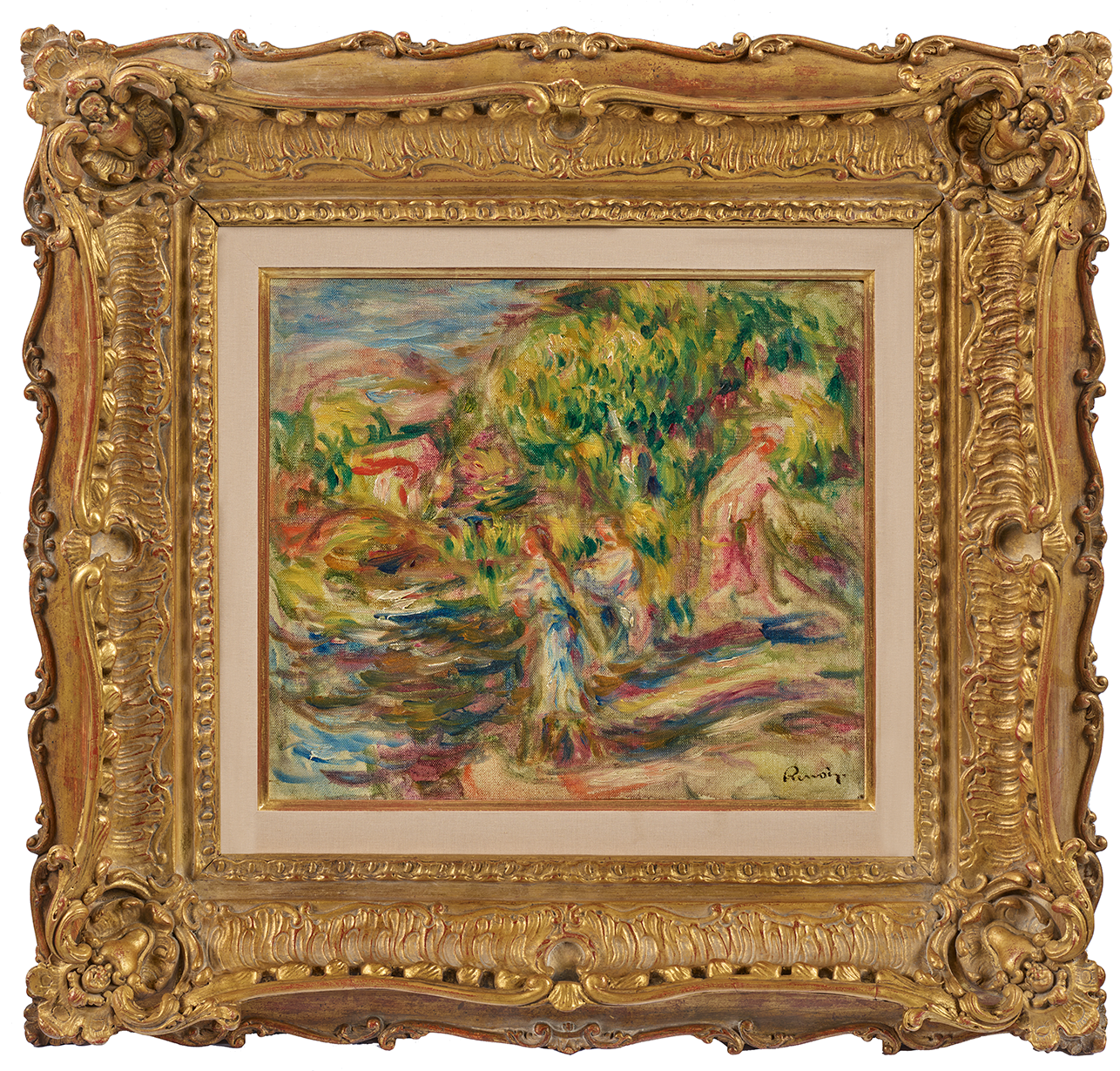
The vibrant sketch we present belongs to the final years of Pierre-Auguste Renoir’s career, when the artist, settled at his estate of Les Collettes in Cagnes-sur-Mer, continued to paint with remarkable freedom despite declining health. Executed around 1916, this small canvas illustrates a familiar theme in his late work: that of washerwomen, modest female figures integrated into a landscape bathed in light.
In this scene, Renoir does not seek descriptive precision but instead privileges impression and movement. At the center of the composition, two female silhouettes, bending over at the water’s edge, are barely suggested by a few colored touches. Their light dresses, animated with whites, pinks, and blues, merge into the surrounding vegetation, almost absorbed by the landscape. Around them, masses of trees and bushes are rapidly rendered with a highly spontaneous, swift, and fluid brushstroke, combining deep greens with luminous ochres and reds. The forms seem almost to dissolve in a whirl of colored touches that evoke the vibration of light more than the precise structure of the motif.
The water of the stream, merely suggested by a few pale bluish strokes, reflects the surrounding tones and contributes to this impression of movement and fluidity. More than the figures—literally dissolved into nature—it is the painting itself, free and luminous, that becomes the true subject of the work under Renoir’s brush. Through the vibrant touches for which he was renowned, the master of Impressionism transforms an everyday scene into a poetic, almost abstract vision in which color and light dominate all narrative.
The history of this painting proves almost as eventful as the century through which it passed. When the Second World War broke out and the German Occupation was established in France, its owner, the Hungarian-Jewish collector and art dealer Alfred Weinberger, hastily left Paris to take refuge in Aix-les-Bains. Before departing, he entrusted several of his paintings—including our Renoir—to the bank Morgan & Cie, believing they would be kept safe. The painting was ultimately seized by Nazi authorities and inventoried by the Einsatzstab Reichsleiter Rosenberg before being deposited at the Jeu de Paume on December 4, 1941. Shortly thereafter, it was transferred to Germany on the orders of Hermann Göring, an episode documented in the ERR photographic archives now preserved at the Bundesarchiv in Koblenz.
Long considered lost, the painting resurfaced several decades later on the art market, having been acquired in good faith by a collector in the 1980s.
It was only during a public sale in 2023 that its looted provenance was rediscovered in archival records. The sale was immediately cancelled and legal proceedings initiated in order to restitute the work to the Weinberger heirs. Now recovered and restored to its rightful provenance, our striking Renoir continues its journey, bearing witness to a destiny in which the history of art is closely intertwined with the dark upheavals of the twentieth century.
Origin
Renoir estate (1919–1922)
Alfred Weinberger Collection from 1925, deposited at Morgan & Co. bank in Paris
Seized, inventoried by the ERR and deposited at the Jeu de Paume on 4 December 1941 under the title ‘Landscape with Apple Trees and Washerwomen’ (ERR photographic archives, held at the Bundesarchiv in Koblenz (Wbg 124)
Transferred to Germany on Göring's orders in 1942
Listed after the war in the Répertoire des biens spoliés en France (Directory of Looted Property in France) (no. 6396) under the name Weinberge
Acquired in good faith in the 1980s by Mrs G. from the Galerie Segoura
Giquello sale, 12 May 2023, then cancellation of the sale and restitution to the Weinberger heirs, who chose to entrust it once again to Giquello
Literature
Albert André, L'atelier de Renoir, Paris, Bernheim-Jeune, 1931, volume II, plate 157, no. 497.
Guy Patrice and Michel Dauberville, Renoir, catalogue raisonné des tableaux, pastels, dessins et aquarelles, 1911-1919, Paris, Bernheim-Jeune, 2014, vol. V, cat. no. 3998 (incorrect dimensions), reproduced on p. 17.
The work will be included in the Digital Catalogue Raisonné currently being prepared by the Wildenstein Plattner Institute (WPI). WPI certificate no. 22.05.16/21049 dated 20 May 2022.
Artworks to discover


75008 Paris, France
Saturdays from 2 to 7 p.m.